
Planting, care, pollination, containers and harvesting for healthier plants and better fruit
Blueberries grow on long-lived woody bushes, not true trees. For healthy growth and reliable fruit, they need acidic, well-drained soil, plenty of sunlight and consistent moisture. The most important step happens before planting: choose a blueberry type suited to your climate and test whether your soil falls within the acidic range the plant needs.
Once those conditions are right, blueberry bushes are relatively straightforward to maintain. They can grow in garden beds, raised beds or large containers, making them useful for both traditional yards and small patios. This guide explains when and how to plant blueberry bushes, how far apart to space them, how much water they need, when to fertilize and what to do when the leaves or fruit show signs of trouble.
Quick answer: Plant blueberries in full sun, in moist but freely draining soil with a pH of about 4.5-5.5. Early spring is usually the safest planting time. Space most highbush plants about 4-5 feet apart, provide roughly 1-2 inches of water per week when rainfall is insufficient, and grow two compatible varieties for a better harvest.
Blueberry Bush at a Glance
| Requirement | Practical guidance |
| Plant type | Perennial woody fruiting shrub |
| Botanical group | Vaccinium species and cultivars |
| Typical size | 6 inches to more than 12 feet, depending on type |
| Sunlight | Full sun; usually 6-8 hours daily |
| Preferred soil pH | Approximately 4.5-5.5 |
| Soil | Acidic, organic-rich, moisture-retentive and well-drained |
| Water | Usually 1-2 inches weekly, adjusted for weather and soil |
| Planting time | Early spring; fall can work in mild climates |
| Pollination | One may fruit, but compatible varieties improve yield |
| First meaningful crop | Often 2-3 years after planting; larger crops later |
| Productive life | Several decades with suitable care |
These figures are useful starting points, not universal rules. Variety, hardiness zone, rainfall, soil texture, container size and plant age all affect the final recommendation. When local guidance differs, follow the advice from your regional cooperative extension or a reputable nursery familiar with your climate.
Is a Blueberry a Tree or a Bush?
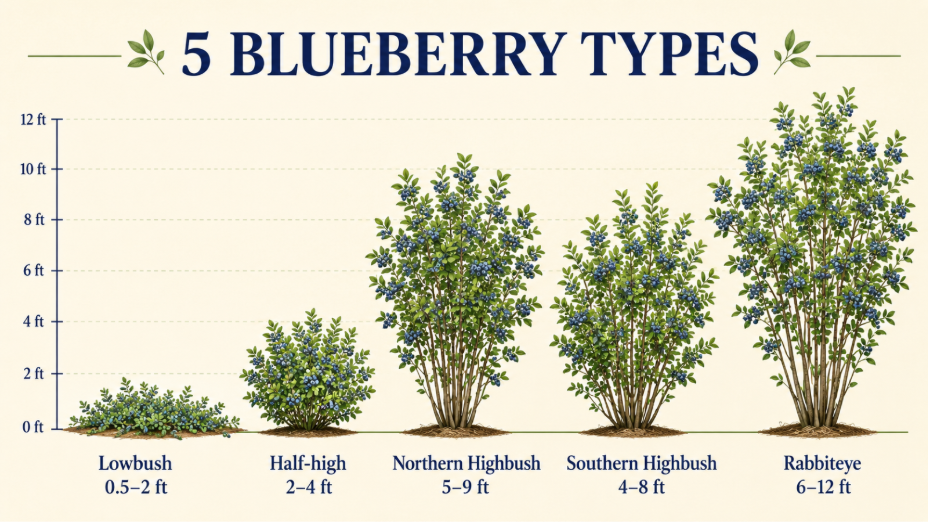
A blueberry is a bush. More precisely, it is a perennial woody shrub from the Vaccinium genus. Some rabbiteye and highbush blueberries can become tall and develop thick, upright canes, so people sometimes call them blueberry trees. Botanically, however, commonly cultivated blueberries remain multi-stemmed shrubs rather than true single-trunk trees.
The growth habit changes considerably by type. Lowbush blueberries may form spreading colonies only a few inches or a couple of feet high. Half-high varieties remain relatively compact. Northern and southern highbush plants commonly become substantial garden shrubs, while unpruned rabbiteye plants can grow tall enough to resemble small trees.

What Does a Blueberry Bush Look Like?
A young blueberry plant usually has several slim green, reddish or tan stems rising from the crown. As the plant matures, those stems become woody canes. The leaves are generally oval to lance-shaped with pointed tips. In many deciduous varieties, foliage turns red, orange or purple in autumn before dropping.
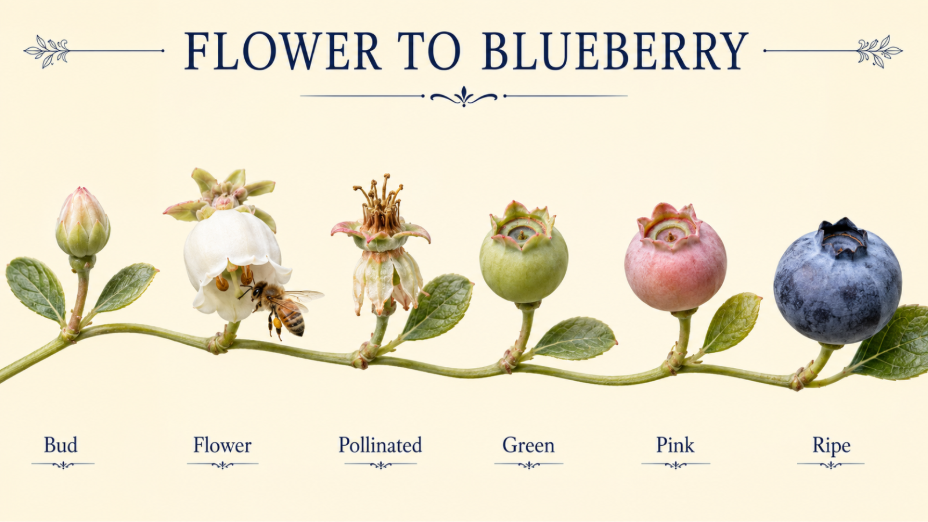
Blueberry flowers are small, white or pale pink and shaped like bells or tiny urns. They appear in clusters, usually on growth formed during the previous season. After successful pollination, each flower can develop into a green berry. The fruit then changes through green and reddish stages before becoming blue or blue-purple. A powdery-looking natural bloom may cover ripe berries; this is normal and helps protect the fruit.
Choose the Right Type of Blueberry Plant
Selecting the correct blueberry type is more important than choosing the variety with the largest picture on the plant label. Blueberries differ in cold tolerance, heat tolerance, chill-hour needs, mature size and pollination behavior. A variety that performs beautifully in a cold northern garden may struggle in a mild-winter southern climate, and the reverse is also true.
| Type | Typical height | General climate fit | What to know |
| Lowbush | 6 in-2 ft | Cold regions; often zones 3-7 | Spreading habit; commonly associated with wild blueberries |
| Half-high | 2-4 ft | Very cold climates; often zones 3-7 | Compact and cold hardy; useful in smaller gardens |
| Northern highbush | 5-9 ft | Cool to temperate regions; often zones 4-8 | Common home-garden type; benefits from cross-pollination |
| Southern highbush | 4-8 ft | Mild-winter regions; often zones 7-10 | Lower chill requirements; select for local heat conditions |
| Rabbiteye | 6-12+ ft | Warm southern regions; often zones 7-9 | Large, vigorous plants; usually require a compatible variety |
Before buying: Check the plant label for hardiness zone, chill-hour requirement, mature width, bloom season and pollination partner. If you need two plants, choose different compatible cultivars that flower at approximately the same time.
When Is the Best Time to Plant Blueberry Bushes?
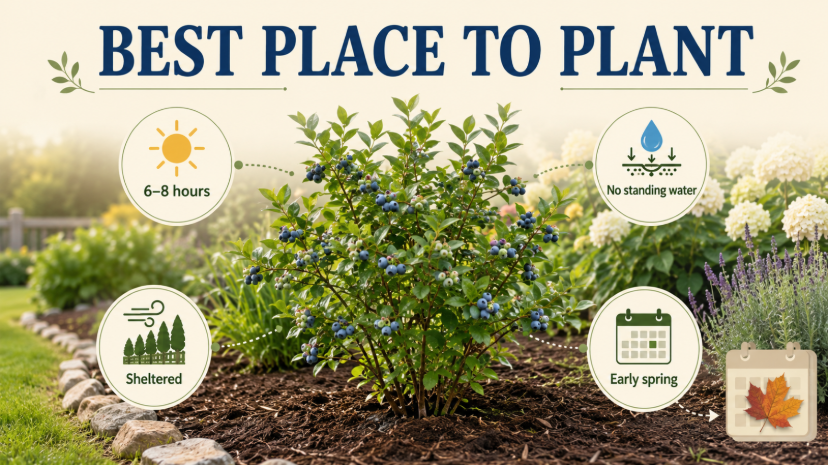
Early spring is the safest planting period in many parts of the United States. Plant while the bush is still dormant or just beginning active growth, after the ground is workable and severe freezing conditions have passed. Cool soil and regular spring moisture help roots establish before summer heat arrives.
Fall planting can also work in regions with mild winters. The soil is often warm enough for root growth while cooler air reduces water stress. In colder climates, however, newly planted roots may not establish before the ground freezes, so spring is generally more dependable. Container-grown nursery plants offer a wider planting window than bare-root plants, but they still should not be planted into frozen, waterlogged, extremely hot or very dry soil.
If your soil needs substantial acidification, preparation may need to begin months before the plant goes into the ground. Elemental sulfur works gradually, and the correct amount depends on the existing pH and soil texture. Testing and amending in advance is safer than trying to force a rapid pH change after planting.
Where Should You Plant Blueberry Bushes?
Choose a position that receives at least six hours of direct sunlight. Eight hours can support stronger flowering and sweeter, heavier crops, although light afternoon shade may be helpful in very hot regions. Avoid deep shade and sites crowded by large trees, which compete for moisture and nutrients while limiting airflow.
Drainage is equally important. Blueberry roots need steady moisture, but they also need oxygen. A low spot that remains saturated after rain can encourage root rot. If the soil drains poorly, use a raised bed or a large container filled with an acidic, freely draining growing medium.
- Select a sunny site with room for the plant at its mature width.
- Avoid locations where water stands after rainfall or irrigation.
- Keep plants away from large tree roots and dense shade.
- Choose a sheltered position if strong winds regularly dry the soil.
- Make sure the site is close enough to a water source for consistent irrigation.
- Avoid planting directly beside concrete foundations or paths if lime leaching may raise soil pH.
Prepare Acidic, Well-Drained Soil
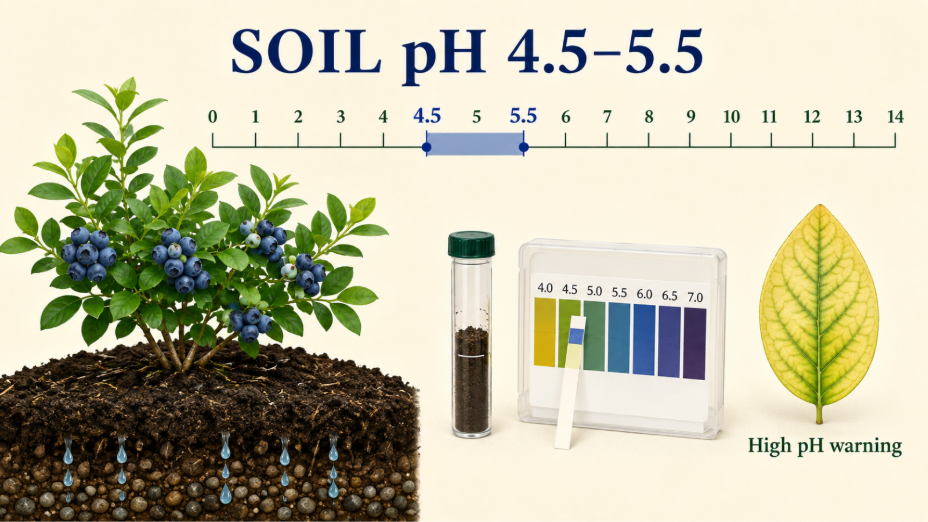
Blueberries are acid-loving plants. Their roots absorb nutrients efficiently only when the soil is sufficiently acidic, generally around pH 4.5-5.5. In soil that is too alkaline, a plant can show iron chlorosis: newer leaves become yellow while the veins remain green. Adding more general fertilizer does not solve the underlying problem if the roots cannot access the nutrients.
Test the soil before planting. A laboratory soil analysis gives the most useful result because it can report pH, organic matter and important nutrient levels. A home test can provide an initial indication, but avoid applying large amounts of sulfur or other acidifiers without knowing the starting pH. Too much amendment can damage roots or make the soil excessively acidic.
Blueberry soil should hold moisture without remaining soggy. Sandy loam amended with suitable low-pH organic matter is often ideal. Heavy clay may stay wet and resist lasting pH adjustment, making a raised bed or container more practical. Be cautious with manure-based compost and mushroom compost, which may have a high pH or salt content. Peat-free ericaceous mixes, fine pine bark and other products intended for acid-loving plants can be useful, especially in containers.
Container decision: If the native soil is strongly alkaline, very heavy or repeatedly returns to a high pH, growing blueberries in a raised bed or pot may be easier than continually trying to change the entire planting area.
How to Plant a Blueberry Bush Step by Step
Prepare the site before removing the plant from its nursery container. Blueberry roots are fine and shallow, so handle the root ball carefully and do not leave it exposed to drying wind or direct sun.
- Water the plant thoroughly. If it is bare-root, keep the roots moist and follow the supplier instructions for soaking before planting.
- Dig a hole about twice as wide as the root ball, but not unnecessarily deep. Wide, loosened soil helps roots spread outward.
- Remove the container and inspect the root ball. Gently loosen circling or densely matted outer roots without tearing the entire root system apart.
- Set the plant so the top of the root ball is approximately level with the surrounding soil. Avoid burying the crown or leaving the upper roots exposed.
- Backfill with the prepared soil, working it around the roots. Firm gently with your hands instead of heavily compacting it.
- Water slowly and deeply to settle the soil and remove large air pockets. Add a little more soil if settling exposes roots.
- Apply 2-4 inches of organic mulch over the root area. Keep mulch a few inches away from direct contact with the canes.
- Check moisture frequently during the first growing season. The root zone should remain evenly moist, not saturated.

Young plants are sometimes allowed to flower too soon. Removing flower buds during the first season, and sometimes the second, directs more energy toward roots and canes. It delays the first handful of fruit but can support a stronger, more productive bush in later years.
How Far Apart Should Blueberry Bushes Be Planted?
Spacing depends on the blueberry type, mature width and whether you want individual shrubs or a continuous hedge. Plants placed too close together can become difficult to prune and harvest, and poor airflow may increase disease pressure. Excessive spacing is not harmful, but it uses more garden space and may reduce the convenience of pollination.
| Planting plan | Typical spacing | Important note |
| Lowbush | 1-2 ft | Allow spreading plants to form a low patch |
| Compact/half-high | 2-4 ft | Confirm the cultivar width on the label |
| Highbush hedge | 2-3 ft | Plants eventually grow together; prune for airflow |
| Individual highbush plants | 4-5 ft | Common home-garden spacing |
| Rabbiteye | 6-8 ft or more | Large, vigorous cultivars need extra room |
| Rows | 6-10 ft between rows | Leave enough access for harvest and maintenance |
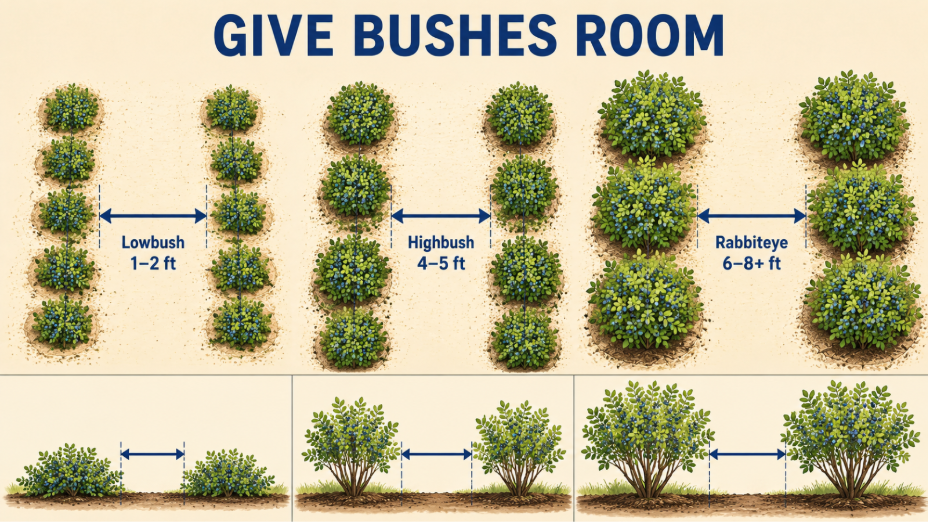
Always compare these general ranges with the mature dimensions listed for the cultivar. A dwarf patio blueberry and a vigorous rabbiteye should not be planted at the same distance.
How Many Blueberry Bushes Should You Plant?
One self-fertile blueberry bush can produce fruit, but two or three compatible varieties usually give a better result. Cross-pollination can improve fruit set, berry size and the overall harvest. The plants do not need to be touching; they simply need to be close enough for pollinating insects to visit both.
Compatibility matters more than buying two plants at random. Choose cultivars of the same general type that bloom at overlapping times. Rabbiteye blueberries usually need another compatible rabbiteye variety because many are not reliably self-fruitful. Some half-high varieties also crop poorly without a pollination partner. A nursery or regional extension variety list can help identify suitable pairings.
Blueberry Bush Care

Watering
Blueberries have shallow roots and dry out faster than many woody shrubs. In general, provide the equivalent of about 1-2 inches of water per week when rainfall does not supply it. Young plants, sandy soil, containers, hot weather and developing fruit may require more frequent attention. Apply water slowly so it reaches the root zone rather than running off the surface.
Drip irrigation or a soaker hose keeps moisture steady and limits unnecessary leaf wetting. Check the soil below the mulch instead of watering by the calendar alone. The goal is evenly moist soil. Constant saturation deprives roots of oxygen, while repeated drought can reduce berry size and weaken flower buds for the following season.
Mulching and Weed Control
Maintain 2-4 inches of organic mulch over the root zone. Fine pine bark, aged wood chips or another locally recommended material can slow evaporation, moderate soil temperature and suppress weeds. Mulch does not replace pH testing, and pine materials should not be expected to rapidly acidify alkaline soil.
Keep grass and weeds away from the bush. Blueberry roots are shallow and compete poorly for water. Pull weeds carefully or use mulch rather than digging deeply around the plant, which can sever fine feeder roots.
Fertilizing Blueberry Plants
Fertilizer recommendations vary by region, plant age and soil-test results. Established plants are commonly fed in early spring as new growth begins, using a product formulated for blueberries, azaleas, rhododendrons or other acid-loving plants. Blueberries generally use ammonium forms of nitrogen more effectively than nitrate-heavy fertilizers.
Do not place fertilizer against the crown or canes, and do not assume that more fertilizer produces more berries. Blueberry roots are sensitive to salts, and overfeeding can burn roots, create excessive soft growth or worsen nutrient imbalances. Some extension guides recommend no fertilizer during the first year; others advise a small application after new leaves emerge. Follow a regional schedule and the label rate for the exact product.
Pruning Blueberry Bushes
Young blueberry bushes need little structural pruning. Remove broken, dead or badly damaged growth, and consider removing flowers while the plant establishes. Once the bush is mature enough to crop, prune during dormancy in late winter or early spring before active growth begins.
- Remove dead, diseased, broken and crossing canes first.
- Cut out weak growth near the ground that will not support good fruit.
- Thin crowded centers so sunlight and air can reach the plant.
- Gradually remove the oldest, least productive canes at ground level.
- Do not remove too much healthy wood in a single year.
Blueberry flower buds form on the previous season’s growth, so indiscriminate trimming can remove the coming crop. Renewal pruning is more useful than shearing the outside of the bush into a tight shape.
How to Grow Blueberries in Pots
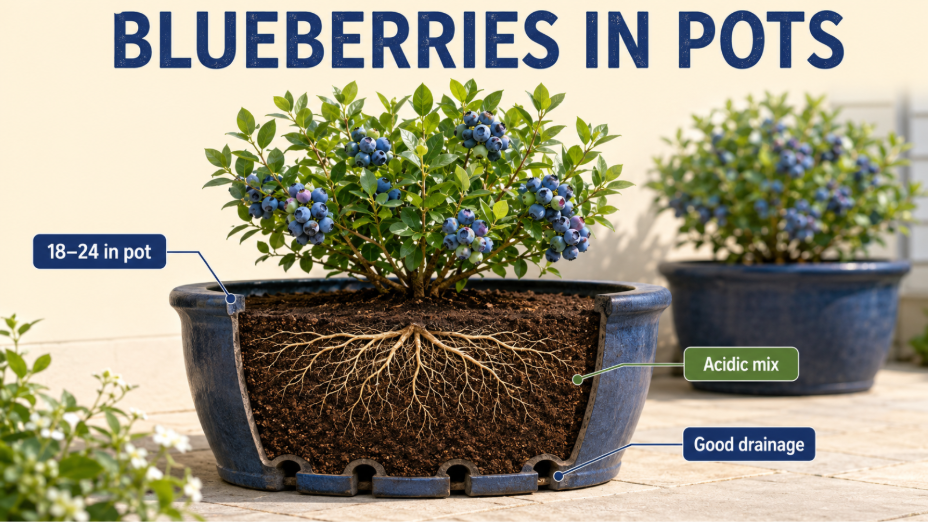
Containers are often the easiest solution for gardeners with alkaline or heavy soil. Select a compact or container-friendly variety and use one plant per pot. Start with a container at least 18-24 inches wide and deep, with several unobstructed drainage holes. A larger weather-resistant pot gives the roots more stable moisture and temperature conditions.
Fill the container with a quality acidic or ericaceous potting mix that drains freely while retaining moisture. Do not use ordinary garden soil in a pot; it can compact and drain poorly. Position the container where it receives six to eight hours of sun, but consider some protection from extreme afternoon heat in very hot climates.
Potted blueberries need closer watering attention because the root ball can dry quickly. Water thoroughly until excess drains, then recheck moisture rather than allowing the container to sit in water. Feed with a product labeled for acid-loving container plants, using the stated rate. Test or monitor the mix periodically, repot when roots crowd the container and protect the pot from severe winter temperature swings.
Blueberry Flowers, Pollination and Fruit Development
Flower buds are generally plumper than leaf buds and form toward the tips of one-year-old shoots. In spring, each bud can open into a cluster of white or pink bell-shaped flowers. Bees and other insects move pollen among flowers and between compatible plants. Cold, rainy or windy weather during bloom can limit pollinator activity, while a late frost can damage open flowers.
After pollination, the base of the flower enlarges into a small green berry. Fruit later develops red or pink tones before becoming blue. Not every blue berry is at peak flavor immediately. Many varieties become sweeter after remaining on the bush for several days beyond the first full color change.
When Will a Blueberry Bush Produce Fruit?
A nursery plant may produce a few berries within two or three years, but substantial crops take longer. The bush spends its early seasons building roots and a framework of productive canes. Many plants approach stronger production around five years after planting and continue improving as they mature, provided their soil, moisture and pruning needs are met.
Growth rate and cropping time depend on the plant’s age at purchase, variety, climate, pollination and care. A bush struggling in alkaline soil may survive without producing a useful crop. Correcting the site conditions is more effective than searching for a quick fertilizer solution.
How to Harvest Blueberries
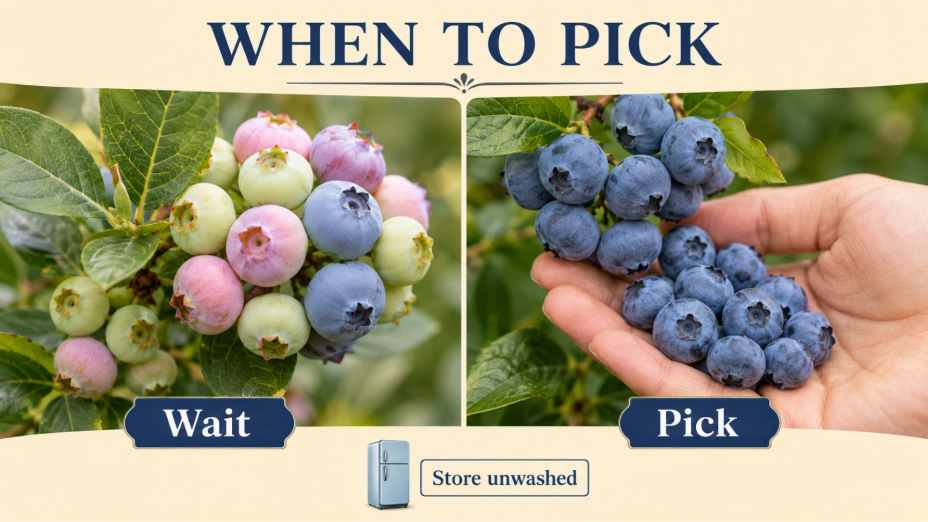
Harvest when berries are uniformly blue, taste sweet and release easily from the stem. Hold a container below a cluster and gently roll ripe berries between your fingers. Fully ripe berries should fall into your hand with little pulling. Leave berries that resist and check them again later.
Pick during dry conditions when possible. Cool the fruit promptly and store it unwashed in the refrigerator so surface moisture does not encourage decay. Wash just before eating or processing. Birds often discover the crop before the gardener does, so use a properly supported fruit cage or wildlife-safe netting before berries begin to ripen. Loose netting can trap birds and small animals, so install and inspect it carefully.
Common Blueberry Plant Problems
| Symptom | Likely explanation | First action |
| Yellow leaves with green veins | Soil pH too high; iron is unavailable | Test pH before adding fertilizer; correct the root cause gradually |
| Bush grows but does not flower | Wrong climate fit, too much shade, excess nitrogen or incorrect pruning | Check chill needs, sun exposure, feeding and pruning timing |
| Flowers form but little fruit follows | Poor pollination, frost damage or incompatible variety | Add a compatible cultivar and support pollinator access |
| Small or shriveled berries | Water stress, weak pollination or excessive crop load | Maintain even moisture and review pollination |
| Wilting despite wet soil | Poor drainage or root rot | Stop routine watering and investigate drainage/root health |
| Brown leaf edges after feeding | Fertilizer salt injury or drought | Water appropriately and avoid additional fertilizer until assessed |
| Berries disappear before harvest | Birds or wildlife | Use a properly installed barrier before ripening |
| Spots, dieback or mummified fruit | Possible fungal or cane disease | Remove affected debris and seek regional diagnosis |

Do not diagnose from one symptom alone. Yellow leaves, for example, can reflect high pH, damaged roots, excessive water or a true nutrient shortage. Review the soil, drainage, recent weather and care history together. When disease is suspected, send clear photographs or a plant sample to a local extension diagnostic service before applying a pesticide.
Are Coffee Grounds Good for Blueberry Plants?
Spent coffee grounds are not a dependable way to acidify soil for blueberries. Brewing removes much of the acidity, and used grounds are commonly close to neutral. Any pH effect is small and temporary compared with a measured amendment such as elemental sulfur. A thick layer of grounds can also compact, interfere with water movement or create an unsuitable surface around shallow roots.
Small amounts of used grounds may be included in a balanced compost pile, but they should not replace a soil test, suitable acidic growing media or a blueberry fertilizer. If the soil pH is high, use the amendment and application rate recommended for the measured pH and soil type.
Myth check: Coffee grounds may contribute organic material when composted correctly, but they should not be promoted as a reliable blueberry soil acidifier.
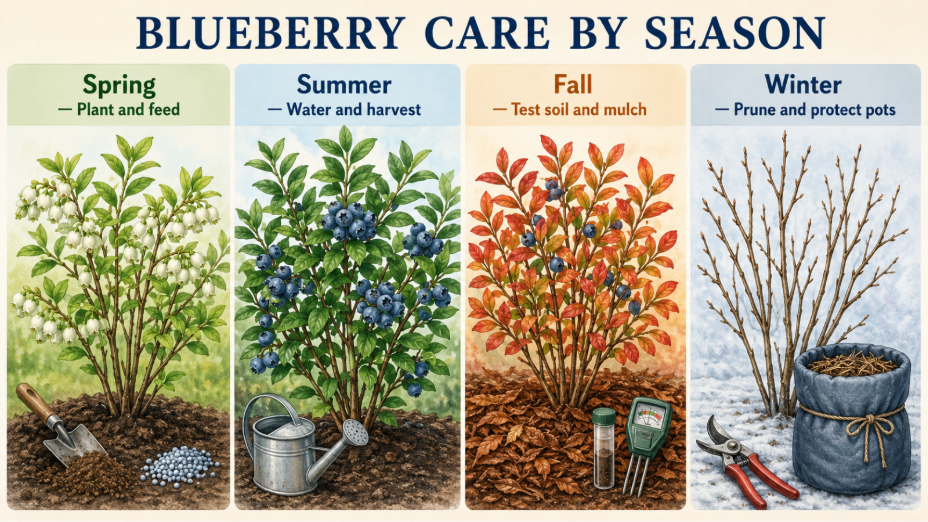
Seasonal Blueberry Care Calendar
| Season | Main tasks |
| Late winter | Prune established dormant bushes; remove damaged and unproductive canes |
| Early spring | Plant in most climates; test soil; feed established plants if recommended |
| Late spring | Watch bloom, pollinator activity, frost risk and moisture |
| Summer | Water consistently, maintain mulch, protect ripening fruit and harvest |
| Fall | Plant in mild climates; test soil; refresh mulch after checking root-zone moisture |
| Winter | Protect exposed containers from severe cold and animal damage |
Frequently Asked Questions
Are blueberries perennial?
Yes. Blueberries are perennial woody shrubs. Most cultivated types are deciduous and return from dormancy each spring.
How big does a blueberry bush get?
Size varies from lowbush plants under two feet to highbush and rabbiteye plants that may exceed eight or even twelve feet. Check the cultivar’s mature dimensions.
Do blueberries grow on trees?
No. Commercial and garden blueberries grow on bushes. Some tall bushes may look like small trees when mature.
Do blueberry bushes need full sun?
They generally fruit best with six to eight hours of direct sun. Partial shade is tolerated by some plants but usually reduces production.
Can one blueberry bush produce fruit?
Many highbush cultivars can produce some fruit alone. Two compatible cultivars with overlapping bloom times normally improve yield and berry size.
How much water does a blueberry bush need?
A common starting point is one to two inches per week from rainfall and irrigation, adjusted for heat, soil, containers and plant age. Keep soil moist but not waterlogged.
When should blueberry bushes be fertilized?
Established bushes are often fertilized as growth begins in spring. The correct product, timing and rate depend on plant age, soil tests and regional guidance.
Can blueberries grow in clay soil?
Heavy clay can remain too wet and may be difficult to acidify. A raised bed or large container with acidic, well-drained mix is often safer.
Can blueberry bushes grow in pots?
Yes. Use a compact variety, a large container with drainage, acidic potting mix, full sun and consistent watering.
What do blueberry flowers look like?
They are small white or pale-pink bells or urns that hang in clusters from the previous season’s growth.
How long do blueberry bushes live?
Well-sited and properly maintained bushes can remain productive for decades. Long-term pH, drainage and pruning care are critical.
Why is my blueberry bush not producing fruit?
Possible causes include a young plant, insufficient sun, unsuitable chill hours, damaged flowers, weak pollination, high soil pH, drought stress or incorrect pruning.
The Bottom Line
Successful blueberry growing begins with three decisions: choose a variety suited to the local climate, confirm the soil is acidic enough and make sure the site drains well. Once those foundations are correct, consistent water, mulch, restrained feeding and gradual renewal pruning can keep a blueberry bush productive for many years.
If the garden soil is unsuitable, do not give up. A large container or raised bed filled with acidic growing mix gives you far more control. Plant a compatible second variety when space allows, protect the crop during ripening and give a young bush time to establish before expecting a full harvest.