


A practical guide to choosing quality topsoil for lawns, garden beds, raised beds, grading and bulk delivery — including cubic-yard calculations and common buying mistakes.
Quick answer: Bulk soil describes how soil is purchased — usually loose by the cubic yard or truckload. Topsoil describes the material itself. Good topsoil can be useful for lawns, new beds, raised-bed mixes, grading and landscaping, but quality varies widely. Before ordering, match the soil to the job, inspect or test the material when possible, and calculate the volume you actually need.
Key buying principle: “Topsoil” is not a guarantee of quality. Texture, organic matter, debris, weed pressure, pH, drainage and source can differ dramatically from one supplier to another.
Topsoil at a Glance
| Question | Quick answer |
| What is topsoil? | The upper mineral-soil layer, or a commercial material intended to serve a similar landscaping/growing function. |
| What is bulk soil? | Loose soil sold by volume, commonly by the cubic yard. |
| Best uses | Lawns, garden beds, raised beds, grading, filling low spots and replacing lost soil. |
| Is all topsoil the same? | No. Composition and quality vary widely. |
| Best texture for many projects | Loam or sandy loam is often desirable because it balances drainage, aeration and water-holding. |
| Can vegetables grow in it? | Yes, if the topsoil has suitable texture, fertility, pH and organic matter; many beds benefit from compost or other amendments. |
| How is it sold? | Bagged or in bulk cubic yards. |
What Is Topsoil?

Topsoil is the upper mineral-soil layer where roots, organic matter, microorganisms, water and air interact most actively. In a natural soil profile, this surface layer is usually darker than the subsoil below because it contains more organic matter. Commercial “topsoil,” however, may be excavated natural soil, screened soil, blended soil, or manufactured material designed for landscaping and planting.
A typical topsoil contains varying proportions of sand, silt and clay, along with organic matter, mineral nutrients, water, air and biological life. The balance of those ingredients — not the word on the bag or delivery ticket — determines whether the material is actually good for your project.
Bulk Soil vs. Topsoil: What Is the Difference?
“Bulk” describes the purchase format. “Topsoil” describes a soil material. You can buy bulk topsoil, bulk garden soil, bulk compost, bulk raised-bed mix or bulk fill material. This distinction matters because a supplier advertising “bulk soil” may offer several products with very different compositions and uses.
| Term | What it means | Typical use |
| Bulk soil | Loose material sold by cubic yard or truckload | Large projects where bags would be expensive or inconvenient |
| Topsoil | Mineral-rich surface soil or commercial equivalent | Lawns, beds, planting areas, final grading |
| Garden soil | Usually soil blended with organic amendments | Planting beds and general garden use |
| Raised-bed mix | Blend designed for raised beds | Raised vegetables, herbs and flowers |
| Fill dirt | Low-cost fill material, often lower in organic matter | Building elevation and deep filling below the planting layer |
Is Topsoil the Same as Dirt?
Not really. “Dirt” is an informal word for loose earth. Topsoil is a more specific term for the surface soil layer or a commercial landscaping material intended to serve that function. Fill dirt is different again: its main purpose is usually volume and grade, not growing quality.
What Is Topsoil Made Of?
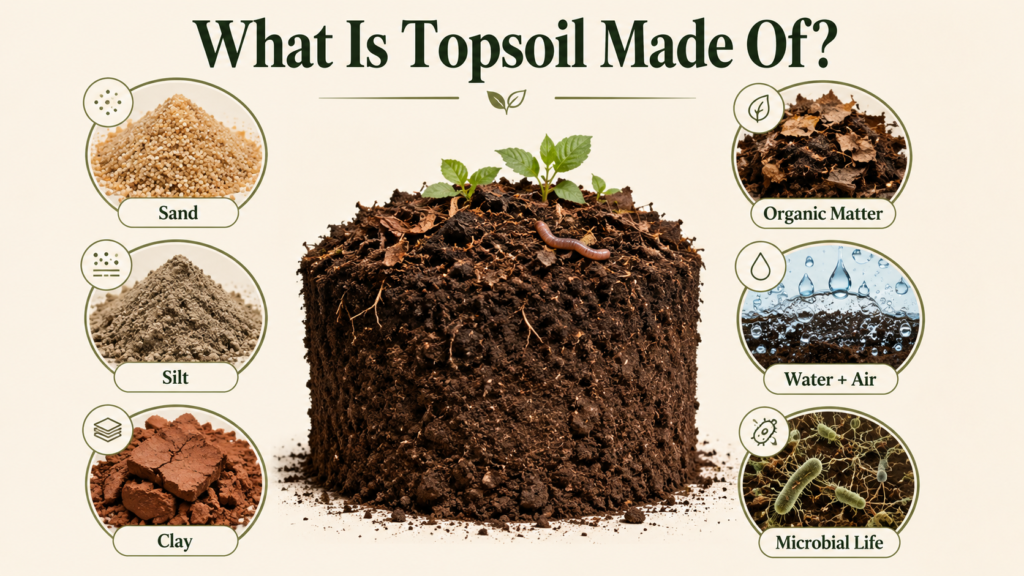
- Mineral particles — sand, silt and clay
- Organic matter from decomposed plant and biological material
- Pore spaces that hold water and air
- Mineral nutrients in amounts that vary by source
- Microorganisms and other soil organisms
- Sometimes added compost or other amendments in blended products
The phrase “topsoil” does not tell you how much of each component is present. One load may be loamy and friable; another may be heavy clay, very sandy, stony, compacted or low in organic matter.
What Is Topsoil Used For?
Topsoil is valuable when you need to create or restore a plant-supporting surface layer. Common uses include:
- Preparing soil for a new lawn or sod
- Creating new flower or vegetable beds
- Adding mineral soil to raised-bed mixes
- Replacing soil removed during construction
- Filling shallow low spots before seeding
- Final grading where the surface will support vegetation
- Increasing usable soil depth over poor or shallow subsoil
Topsoil for Lawns
For a new lawn, topsoil creates the root-zone layer that supports grass establishment. A loamy, screened material is usually easier to grade and seed than very clayey or stony soil. Where usable soil is missing, a several-inch layer is typically required; the RHS uses about 10 cm (4 in.) as a practical minimum benchmark for new lawns in poor or soil-deficient sites.
New Lawn vs. Existing-Lawn Topdressing
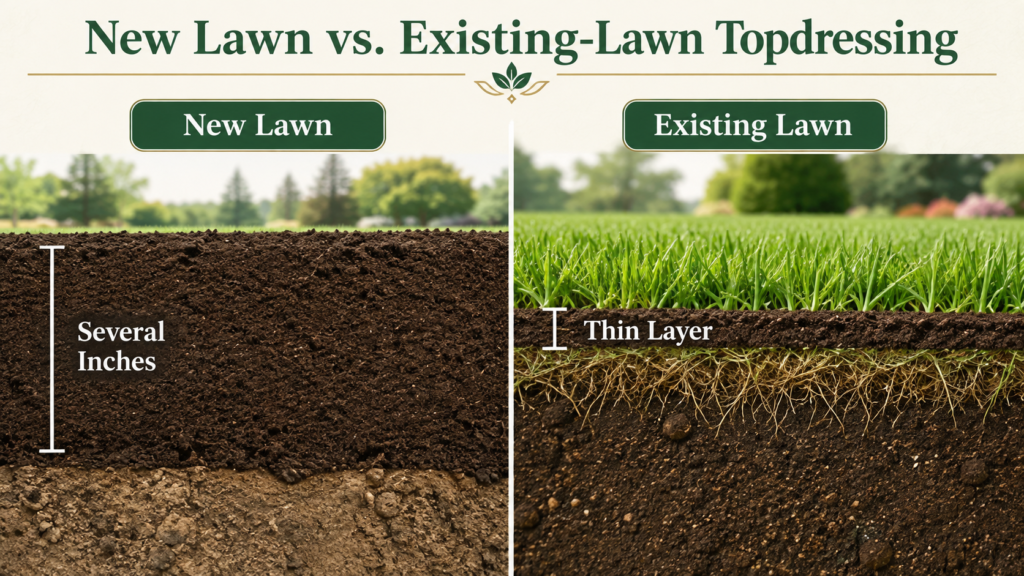
Do not confuse lawn establishment with topdressing. A new lawn may need several inches of soil before seeding or sod installation. An existing lawn normally receives only a thin topdressing layer so the grass is not buried.
Best Topsoil for Lawns
- Loamy or sandy-loam texture
- Screened enough for smooth finish work
- Low in stones, roots and construction debris
- Good drainage without drying excessively fast
- Reasonable pH for turf
- Consistent material across the entire load
Topsoil for Garden Beds and Vegetables
Quality topsoil can be an excellent base for garden beds, but “topsoil” does not automatically mean “ready for vegetables.” Vegetable beds need suitable drainage, organic matter, nutrient availability and pH in addition to enough soil depth.
Practical rule: Use good topsoil for the mineral structure of a bed, then adjust organic matter and fertility according to the actual material and the crops you plan to grow.
Is Topsoil Good for Raised Beds?
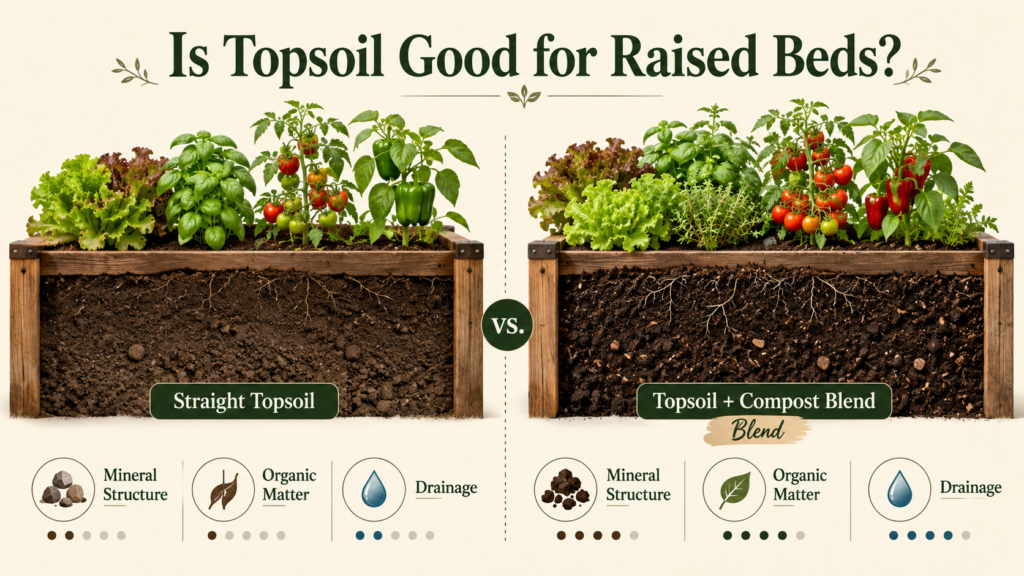
Yes — good topsoil can be an important component of a raised-bed mix. Straight mineral topsoil, however, may become dense or low in organic matter if used alone. Many gardeners blend quality topsoil with finished compost or another suitable amendment so the bed has both mineral structure and organic matter.
Avoid treating one internet ratio as universal. A 60/40 or 50/50 mix may work with one supplier’s materials and perform poorly with another. The right blend depends on texture, compost maturity, drainage, organic matter and the crops being grown.
Can You Plant Flowers Directly in Topsoil?
You can plant flowers in good-quality topsoil if the texture, drainage, pH and fertility suit the plants. Poor topsoil may need compost, fertilizer, pH correction or drainage improvement first. The same principle applies to vegetables: evaluate the soil, not the label alone.
Does Topsoil Have Nutrients?
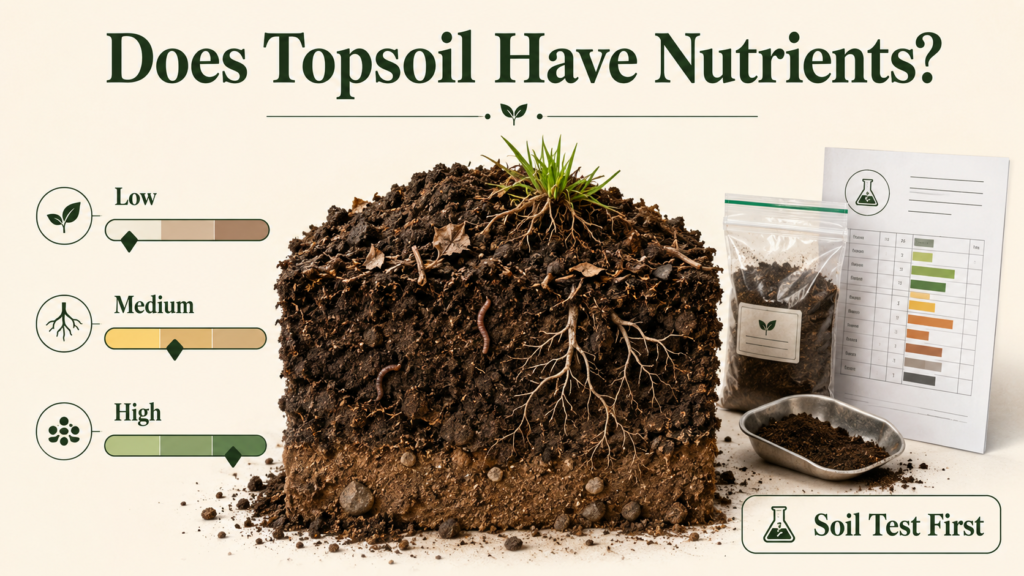
Yes, but nutrient levels vary widely. Natural topsoil often contains more organic matter and biological activity than deeper subsoil, yet purchased material may have low, moderate or high fertility depending on its source and how it was blended. For large or valuable projects, a soil test is more reliable than assuming the material is nutrient-rich.
Topsoil vs. Garden Soil
| Feature | Topsoil | Garden soil |
| Main role | Provides mineral soil, structure and volume | Usually intended as a planting blend |
| Composition | Variable sand/silt/clay + organic matter | Often soil plus compost or other amendments |
| Organic matter | Can be low or moderate | Usually higher, but product-dependent |
| Best uses | Lawns, grading, bed base, landscaping | Vegetable and flower beds |
| Containers | Usually too dense alone | Still not always ideal; potting mix is usually better |
Topsoil vs. Potting Mix
Topsoil is usually too dense for containers when used by itself. Potting mixes are engineered for aeration, drainage and moisture management in confined root zones and are often mostly soil-free. Use topsoil for ground-based projects; use a suitable potting mix for pots and planters unless a specific container recipe calls for otherwise.
Topsoil vs. Compost
Topsoil provides mineral structure and growing volume. Compost primarily contributes organic matter and some nutrients. They complement each other, but they are not interchangeable. Filling a large bed with compost alone can create problems just as filling it with poor mineral topsoil can.
Topsoil vs. Mulch
| Material | Where it goes | Main purpose |
| Topsoil | In the root zone | Provides soil depth, structure and plant-supporting volume |
| Mulch | On top of the soil | Reduces evaporation, suppresses weeds, moderates temperature and protects the surface |
Types and Grades of Topsoil
Supplier terminology is not perfectly standardized, but several categories appear repeatedly in the market.
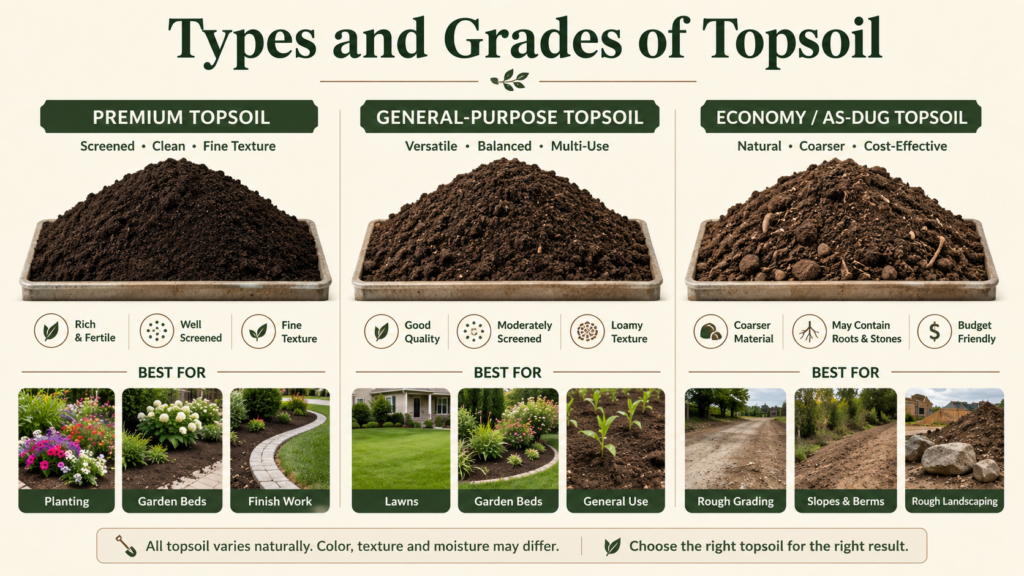
Premium Topsoil
Usually screened and intended for higher-value planting or finish work. It should have a workable texture, limited debris and better consistency than economy material.
General-Purpose Topsoil
A versatile landscaping product for lawns, beds and general site work. Quality can still vary, so inspect the material rather than relying only on the grade name.
Economy or As-Dug Topsoil
Lower-cost soil with less processing. It may contain more stones, roots and coarse material and is better suited to rough landscaping or situations where appearance and fine texture are less important.
Screened vs. Unscreened Topsoil
| Type | What screening changes | Best use |
| Fine screened | Removes more coarse debris and stones | Lawn finish work, thin layers, refined beds |
| Screened general-purpose | Reduces rocks, roots and larger debris | Most lawn and garden projects |
| Unscreened / as-dug | Retains more coarse material | Rough grading, deeper fill where finish quality is less important |
Screened does not mean fertile, weed-free or contaminant-free. Screening mainly changes particle/debris size. You still need to judge texture, source and growing quality.
What Makes Good-Quality Topsoil?
Good topsoil should match the intended project. For gardens and lawns, look for a workable, reasonably loamy material rather than extremes of heavy clay or coarse sand.
| Check | What to look for | Warning signs |
| Texture | Crumbly, workable loam or sandy loam for many landscape uses | Sticky heavy clay, pure sand or highly compacted clods |
| Debris | Low stone, root, plastic, brick and glass content | Construction debris or excessive rock |
| Smell | Normal earthy smell | Chemical, fuel, sewage or other unusual odor |
| Weeds | Few visible roots, shoots or invasive fragments | Rhizomes, weed seedlings or unknown vegetation |
| Drainage | Moist but not waterlogged; breaks apart when handled | Smears heavily or stays saturated |
| Consistency | Similar texture throughout the pile/load | Multiple obvious soil types mixed together |
| Testing | Supplier analysis or soil test where appropriate | No source information for a high-value project |
Is “Weed-Free” Topsoil Really Weed Free?
Treat “weed-free” cautiously. Screening can remove roots and larger plant fragments, but it cannot guarantee that every viable weed seed is gone. Ask how the soil was sourced and processed, inspect for roots and shoots, and monitor new beds after installation.
Topsoil for Grading and Yard Leveling
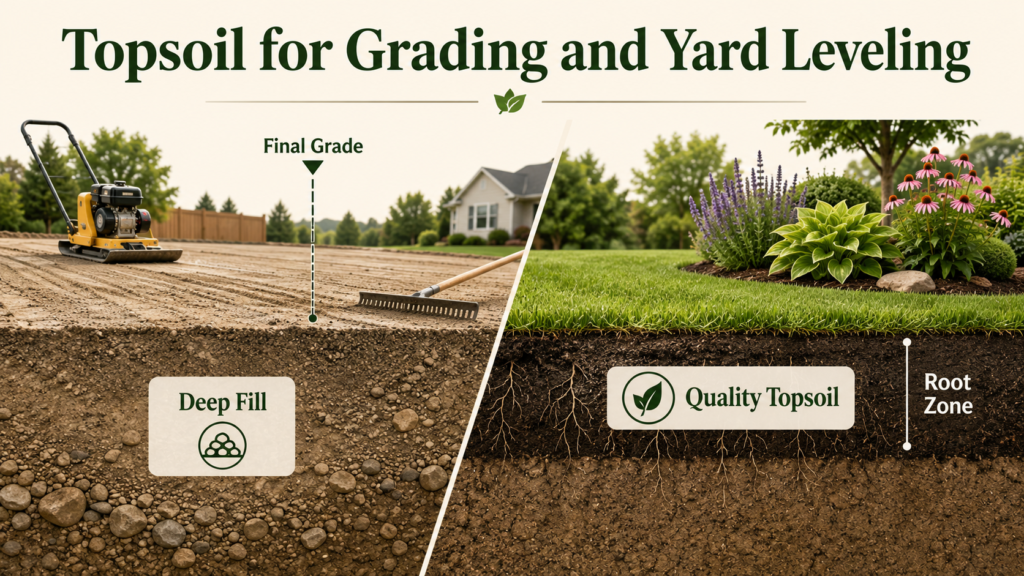
Topsoil is useful for final grading when the finished surface must support grass or other plants. For deep fills, however, premium topsoil is often unnecessary and expensive. A common approach is to use suitable fill material for the lower volume, compact and grade it appropriately, then finish with quality topsoil in the plant root zone.
How Deep Should Topsoil Be?
Depth depends on the project. There is no single correct thickness for every use.
| Project | Typical approach |
| Existing-lawn topdressing | Thin layer only; avoid burying grass |
| New lawn on poor/shallow soil | Around 4 in. (10 cm) is a useful baseline where adequate soil is absent |
| New garden bed | Around 8 in. (20 cm) or more where a planting layer must be created |
| Raised bed | Depends on total bed depth and what material is underneath |
| Low-spot repair | Enough to correct the depression, often added in stages on existing turf |
| Final grading | Enough topsoil to create a usable plant-supporting finish layer |
What Is a Cubic Yard of Topsoil?
Bulk topsoil is commonly sold by the cubic yard. One cubic yard is a volume measuring 3 ft × 3 ft × 3 ft, which equals 27 cubic feet.
| Depth | Approx. area covered by 1 cubic yard |
| 1 inch | 324 sq ft |
| 2 inches | 162 sq ft |
| 3 inches | 108 sq ft |
| 4 inches | 81 sq ft |
| 6 inches | 54 sq ft |
| 12 inches | 27 sq ft |
How Much Topsoil Do You Need?
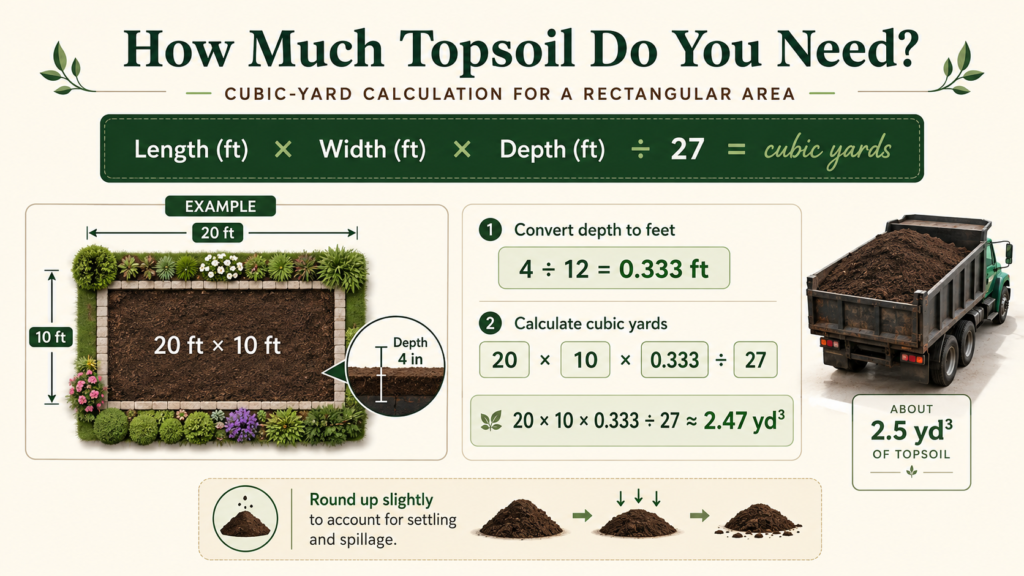
Use this formula for rectangular areas:
| Topsoil formula: Length (ft) × Width (ft) × Depth (ft) ÷ 27 = cubic yards |
Example: A 20 ft × 10 ft area needs 4 inches of topsoil. Convert 4 inches to feet: 4 ÷ 12 = 0.333 ft. Then calculate 20 × 10 × 0.333 ÷ 27 ≈ 2.47 cubic yards.
For real projects, round up modestly to allow for settling, small measurement errors and uneven ground. Avoid extreme over-ordering simply “to be safe.”
Bulk Soil vs. Bagged Soil
| Factor | Bulk soil | Bagged soil |
| Best for | Large lawns, multiple beds, raised beds, grading | Small repairs, a few containers or minor bed work |
| Cost per unit | Usually lower for large volumes | Usually higher |
| Convenience | Requires delivery/access and handling | Easy to move in small quantities |
| Quality check | You may be able to inspect supplier stock before delivery | Label provides some product information |
| Storage | Needs a place for the pile | Easy to store in sealed bags |
How to Buy Quality Bulk Topsoil
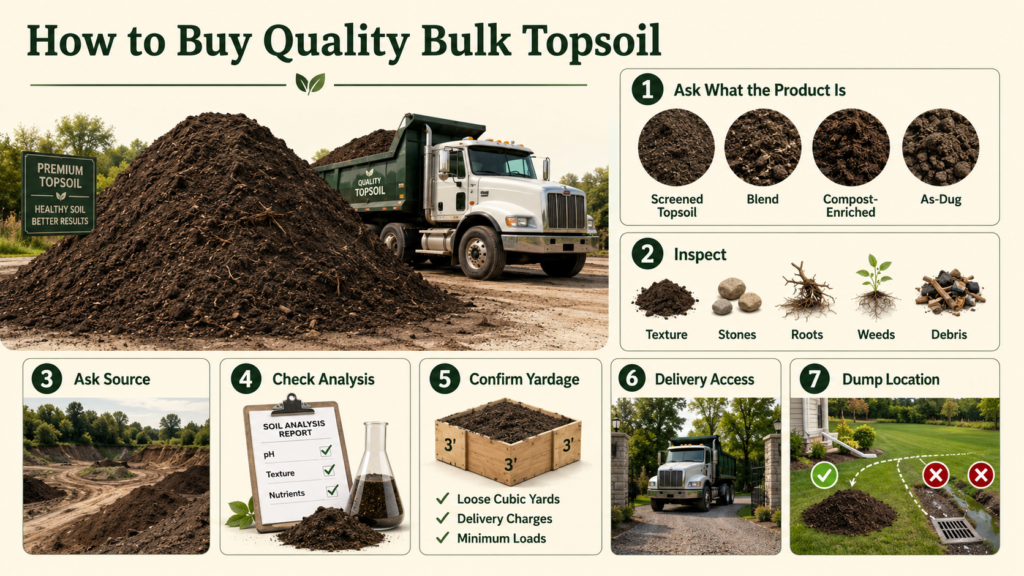
Buying several cubic yards is expensive and difficult to reverse after a truck unloads it. Do the quality check before delivery.
- Ask what the product actually is. Is it screened natural topsoil, a manufactured blend, compost-enriched soil or as-dug material?
- Inspect the pile if possible. Check texture, debris, stones, roots, weeds and consistency.
- Ask where it came from. Soil from unknown construction or industrial sites deserves extra caution.
- Request available analysis. pH, texture and nutrient data are especially useful for lawns, vegetables and high-value beds.
- Confirm whether the quoted yardage is loose cubic yards and whether delivery charges or minimum loads apply.
- Check delivery access. A loaded truck is heavy and may damage soft ground, paving or irrigation systems.
- Plan where the pile will go before delivery. Keep it away from drains and places where runoff will carry soil away.
Should You Accept Free Topsoil?
Free topsoil can be useful, but the price does not tell you the risk. Before accepting it, ask about the source, prior land use, herbicide history, invasive weeds, construction debris, stones and unusual odors. If the source is uncertain and the soil will be used for vegetables or a major landscape project, testing may be worth far more than the money saved.
Common Topsoil Buying Mistakes
| Mistake | Why it causes problems | Better approach |
| Assuming dark soil is automatically good | Color does not guarantee texture, fertility or cleanliness | Inspect texture and source; test when appropriate |
| Buying without seeing the material | Quality can vary greatly by supplier and load | Inspect supplier stock or request representative photos/sample |
| Filling vegetable beds with unknown soil | May have poor drainage, pH, fertility or contamination | Use known-quality soil and amend/test as needed |
| Using topsoil in pots | It can compact and drain poorly in containers | Use potting mix designed for containers |
| Using premium topsoil for deep fill | Wastes money below the active root zone | Use suitable fill below and topsoil near the surface |
| Ordering by guess | Creates costly shortages or surplus | Calculate cubic yards before ordering |
| Assuming screened means fertile | Screening removes coarse material, not fertility problems | Check composition and soil properties |
| Using topsoil as mulch | Topsoil and mulch serve different functions | Use mulch on top of finished soil |
Frequently Asked Questions
What is topsoil?
Topsoil is the upper mineral-soil layer, or a commercial material intended to provide similar structure and growing volume for landscaping and planting.
What is topsoil used for?
Common uses include new lawns, garden beds, raised-bed mixes, final grading, filling shallow low areas and replacing soil lost during construction.
What is topsoil made of?
It usually contains varying amounts of sand, silt, clay, organic matter, nutrients, water, air and biological life.
Does topsoil contain nutrients?
Yes, but nutrient levels vary widely. A soil test is more reliable than assuming topsoil is fertile.
Is topsoil the same as garden soil?
No. Garden soil is usually a planting blend with added organic amendments, while topsoil is primarily a mineral-soil material.
Can vegetables grow in topsoil?
Yes, if the soil has suitable texture, drainage, fertility, pH and organic matter. Many vegetable beds benefit from compost or other amendments.
Can you use topsoil in raised beds?
Yes, as part of a quality raised-bed mix. Straight topsoil may be too dense or low in organic matter depending on the product.
What is screened topsoil?
Topsoil that has been passed through a screen to remove larger rocks, roots and debris. Screening does not guarantee fertility or weed-free soil.
