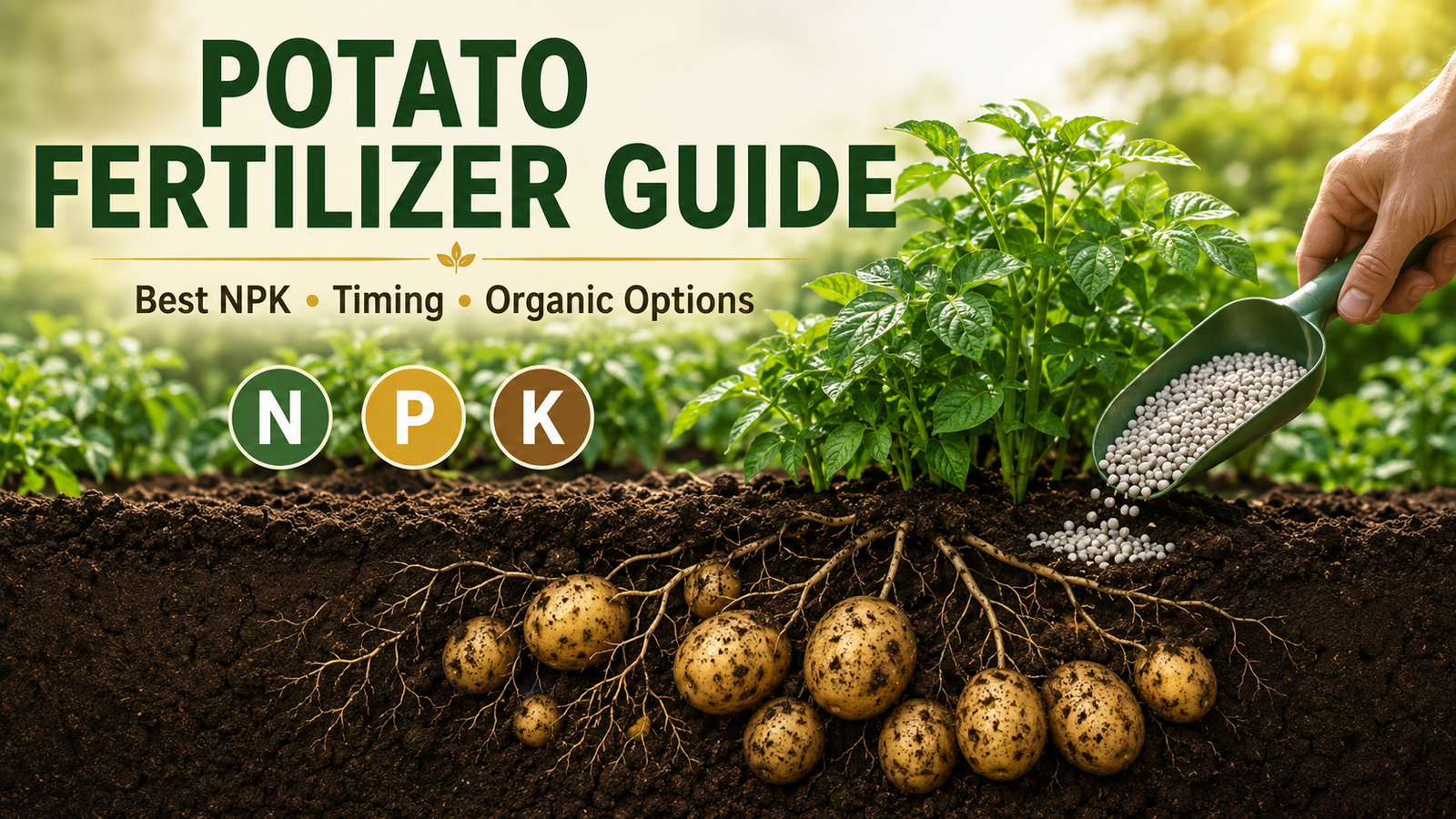

Potatoes need nitrogen, phosphorus, potassium and other nutrients to build a productive crop, but there is no single fertilizer ratio that is perfect for every garden. The best potato fertilizer is the one that corrects what your soil actually lacks, at the stage when the plants need it. A soil test is therefore the best starting point. When testing is not available, commonly used garden fertilizers such as 5-10-10 or, in some soils, 10-10-10 can be reasonable options when applied according to local guidance and the product label.
| Quick answer For most home gardeners, start with a soil test if possible. Potatoes need all three primary nutrients: nitrogen (N), phosphorus (P) and potassium (K). Avoid treating nitrogen as “bad”; potatoes need it, especially early, but excessive or late nitrogen can keep plants focused on foliage and delay maturity. Apply concentrated fertilizer beside or below seed pieces rather than directly against them, and use a staged feeding plan rather than fertilizing every week. |
Potato Fertilizer at a Glance
| Question | Practical answer |
| Best fertilizer for potatoes | The fertilizer that matches your soil test and crop stage. |
| Common general option | 5-10-10 is commonly recommended where additional phosphorus and potassium are appropriate. |
| Can 10-10-10 be used? | Yes. Several extension programs use balanced fertilizers in suitable soils; it is not universally wrong for potatoes. |
| Most important nutrients | Nitrogen, phosphorus and especially adequate potassium, plus secondary and micronutrients where deficient. |
| When to fertilize | Before/at planting and during early growth as needed; exact timing depends on soil, fertilizer and region. |
| Late heavy nitrogen | Usually avoid unless a tested recommendation specifically calls for it. |
| Soil pH | Potatoes generally prefer slightly acidic soil, commonly around pH 5 to 6. |
| Organic choices | Compost plus a complete organic fertilizer or targeted nutrient sources when testing shows a need. |
Do Potatoes Need Fertilizer?
Potatoes are productive plants that remove a meaningful amount of nutrients from the soil as they build vines, roots and tubers. In a fertile garden bed with a strong history of compost additions, they may need less supplemental fertilizer than potatoes grown in depleted soil, sandy soil or fresh container mix. The key question is not simply “Do potatoes need fertilizer?” but “Which nutrients are limiting in this soil?”
A soil test is the most reliable way to answer that question. It can show soil pH and, depending on the laboratory, levels of phosphorus, potassium, organic matter and other indicators. Local extension recommendations then translate those numbers into practical fertilizer rates for your soil and climate.
What Nutrients Do Potatoes Need to Grow?

Potatoes need the same three primary macronutrients shown on fertilizer labels—N, P and K—but their roles are different. Understanding those roles makes fertilizer selection much easier than memorizing a single bag number.
Nitrogen (N): Necessary for Early Growth, Easy to Overdo
Nitrogen supports leaf development, chlorophyll formation and the canopy that powers photosynthesis. Potatoes absolutely do need nitrogen. The common warning about nitrogen comes from timing and excess, not because nitrogen is inherently harmful to potatoes.
Too little nitrogen can produce pale, weak plants with limited canopy growth. Too much nitrogen, especially later in the crop, can keep the vines lush and vegetative, delay maturity and upset the balance between top growth and tuber development. That is why many potato programs split nitrogen rather than applying a very large dose all at once.
Phosphorus (P): Useful, but Soil Levels Matter
Phosphorus supports energy transfer, root establishment and other growth processes. It is often emphasized in potato fertilizer advice, which is why formulas such as 5-10-10 are popular. But “potatoes grow underground, therefore they always need high phosphorus” is too simplistic. If a soil already contains abundant phosphorus, adding more may offer little benefit and can contribute to nutrient imbalance or environmental loss.
Use phosphorus because the soil and crop need it—not simply because potatoes form tubers underground.
Potassium (K): A Major Potato Nutrient
Potatoes have a substantial potassium requirement. Potassium helps regulate water movement in the plant and is associated with tuber yield, quality, stress response and storage characteristics. This is why “potash for potatoes” is a common recommendation and why many potato fertilizers contain relatively generous potassium.
More potassium is not automatically better. Very high rates can alter nutrient balance and, in commercial production, may affect tuber quality traits. The practical home-garden rule is to make sure potassium is adequate without treating potash as something that should be added blindly every season.
What About Calcium, Magnesium and Micronutrients?
Potatoes also need calcium, magnesium, sulfur and small amounts of micronutrients such as boron, manganese, zinc and iron. Most home gardeners do not need to manage these individually unless a soil or tissue test identifies a deficiency. A complete fertilizer and healthy soil organic matter usually supply a broad nutrient base.
What Is the Best Fertilizer for Potatoes?
The best fertilizer for potatoes is not defined by one universal NPK ratio. It should supply the nutrients your soil is short of without adding unnecessary excesses. That is why university recommendations differ: one region may suggest 5-10-10 when no soil test is available, while another may use a balanced fertilizer such as 10-10-10 or a formula with little or no phosphorus where soils already test high in P.
For a home gardener, a good decision order is:
1. Use a soil test and local extension recommendation if available.
2. If no soil test is available, choose a general vegetable or potato fertilizer supported by local guidance and follow its label rate.
3. Avoid adding several separate amendments simply because each is “good for potatoes.”
4. Adjust later feeding to plant growth, soil conditions and the fertilizer already applied.
What Is the Best NPK Ratio for Potatoes?
NPK numbers show the percentage by weight of nitrogen, available phosphate and soluble potash in the product. For example, a 5-10-10 fertilizer contains 5% nitrogen, 10% phosphate and 10% potash. Those numbers describe the fertilizer, not the exact ratio a potato plant must receive.
| Why recommendations differ A 5-10-10 recommendation, a 10-10-10 recommendation and a low-phosphorus recommendation can all be reasonable in different soils. Existing nutrient levels, soil texture, irrigation, yield goal and growth stage change what the crop needs from added fertilizer. |
5-10-10 vs. 10-10-10 Fertilizer for Potatoes

| Fertilizer | Why gardeners use it | Main caution |
| 5-10-10 | Provides less nitrogen relative to phosphorus and potassium; commonly recommended for potatoes in some home-garden guidance. | Not ideal if the soil already contains plenty of P or K. |
| 10-10-10 | Balanced all-purpose fertilizer; used in some extension recommendations where a balanced input fits the soil. | May supply more nitrogen or phosphorus than some soils require. |
| Soil-test-based formula | Targets the nutrients actually deficient in your garden. | Requires testing, but gives the best basis for a precise decision. |
Is 5-10-10 Fertilizer Good for Potatoes?
Yes, 5-10-10 can be a good potato fertilizer when your soil needs phosphorus and potassium and a moderate amount of nitrogen. It is a common recommendation in home-garden guidance because it avoids an extremely nitrogen-heavy formula while still supplying all three primary nutrients. Use the labeled rate or a local extension rate rather than assuming more will produce more potatoes.
Is 10-10-10 Fertilizer Good for Potatoes?
Yes, it can be. Balanced 10-10-10 fertilizer is not automatically “too high in nitrogen” for potatoes. Several extension programs use balanced fertilizer recommendations in appropriate situations. The real question is whether your soil needs similar amounts of added N, P and K. If your soil already contains high phosphorus, for example, a different formula may make more sense.
Test Your Soil Before Fertilizing Potatoes
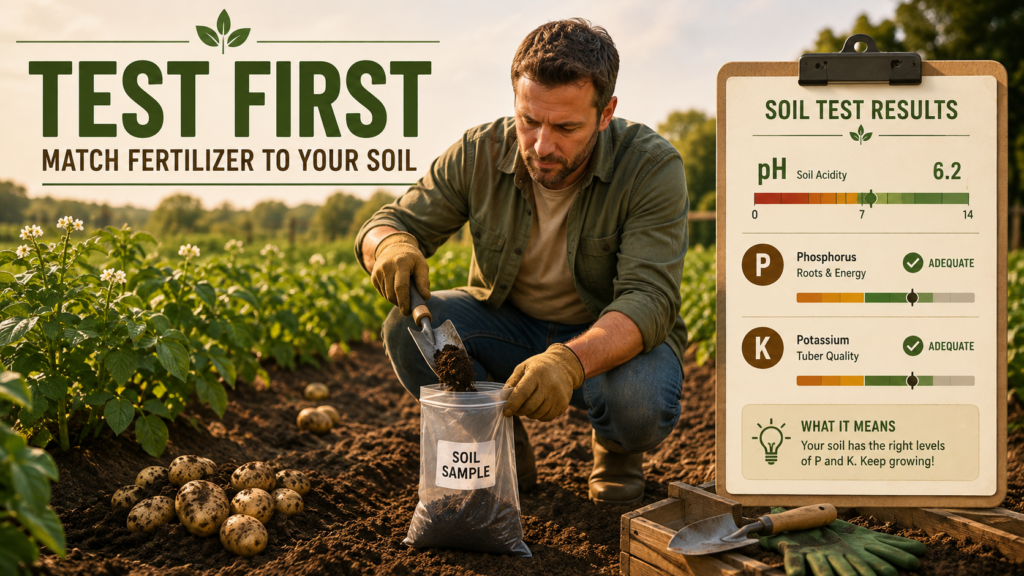
A soil test is one of the easiest ways to avoid both underfeeding and overfertilizing. Ideally, test before planting so you can correct pH and major nutrient deficiencies before the crop begins rapid growth.
- Check soil pH.
- Review phosphorus and potassium results.
- Use local recommendations for nitrogen because many basic soil tests do not give a simple nitrogen number.
- Consider soil texture: sandy soils can lose nitrate and potassium more readily through leaching.
- Retest periodically instead of repeating the same fertilizer program forever.
What Soil pH Do Potatoes Like?
Potatoes generally perform well in slightly acidic soil, often around pH 5 to 6, though extension programs publish somewhat different acceptable ranges for local soils and production systems. Avoid chasing an exact decimal number. The broader goal is a well-drained, slightly acidic root zone with nutrient availability appropriate for potatoes.
Soil pH also matters because common scab tends to be more troublesome in less-acidic conditions in many soils. This is one reason gardeners should not casually add lime or wood ash to potato beds without a soil test. Wood ash can supply potassium, but it also raises pH, which may be undesirable in a potato bed.
Potato Fertilizer Schedule
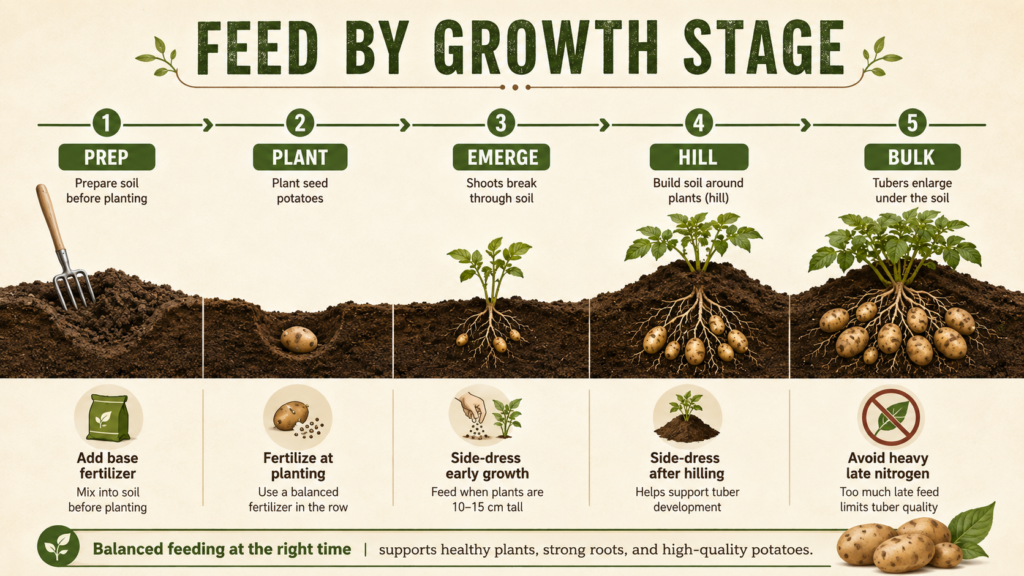
A growth-stage schedule is more useful than a rigid calendar because planting dates, soil temperature and crop development vary. The table below shows the purpose of feeding at each stage rather than prescribing one universal rate.
| Growth stage | Main fertilizer goal | What to avoid |
| Before planting | Test soil; correct pH or major nutrient deficiencies; incorporate recommended base fertilizer. | Adding random amendments without knowing what the soil needs. |
| At planting | Support establishment with the recommended starter/base nutrients. | Putting concentrated fertilizer directly against seed pieces. |
| Emergence / early canopy | Provide nitrogen and other nutrients needed for early vegetative growth if the program calls for a split application. | Heavy feeding simply because growth looks slow in cool weather. |
| Plants about 6-8 inches / hilling | Side-dress if recommended; many home-garden schedules apply a second portion here. | Piling fertilizer directly onto stems or leaves. |
| Tuber initiation and early bulking | Maintain balanced nutrition, especially adequate potassium, without excessive late nitrogen. | Trying to force tuber growth with a very large fertilizer dose. |
| Late season | Allow plants to mature; continue normal care unless a tested program calls for more nutrition. | Routine heavy nitrogen feeding close to harvest. |
How to Fertilize Potatoes at Planting
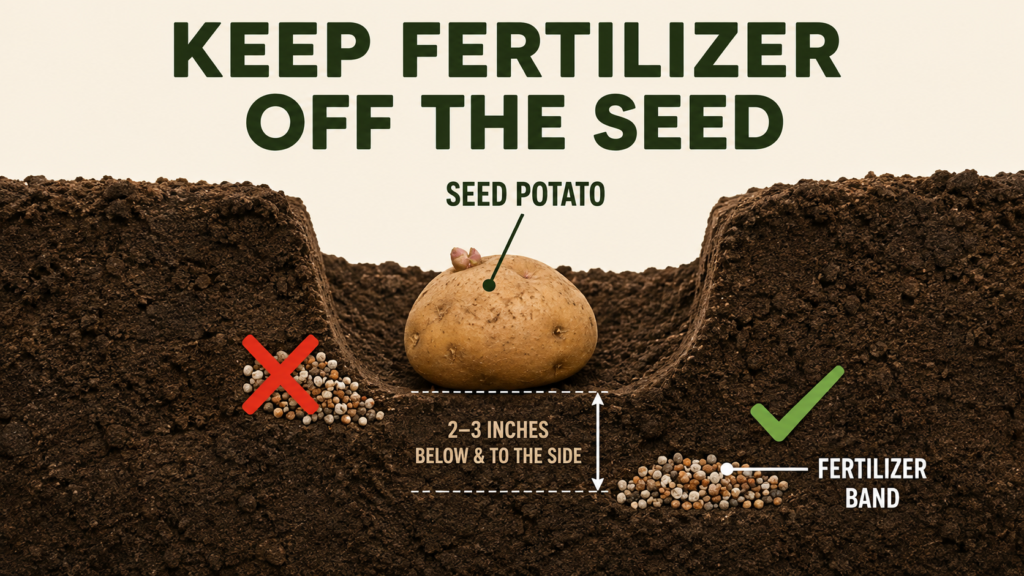
At planting, the safest approach is to keep concentrated fertilizer away from direct contact with the seed potato. Extension guidance commonly places fertilizer in a band beside and slightly below the seed piece or incorporates it into the surrounding soil before planting. Direct contact can create a high-salt zone and increase the risk of seed-piece injury.
1. Prepare the bed and incorporate any soil-test-recommended amendments.
2. Apply the fertilizer at the labeled or locally recommended rate.
3. Keep concentrated fertilizer separated from the seed piece rather than dropping seed directly onto a fertilizer band.
4. Cover and plant normally, then water according to soil conditions.
How to Side-Dress Potato Plants
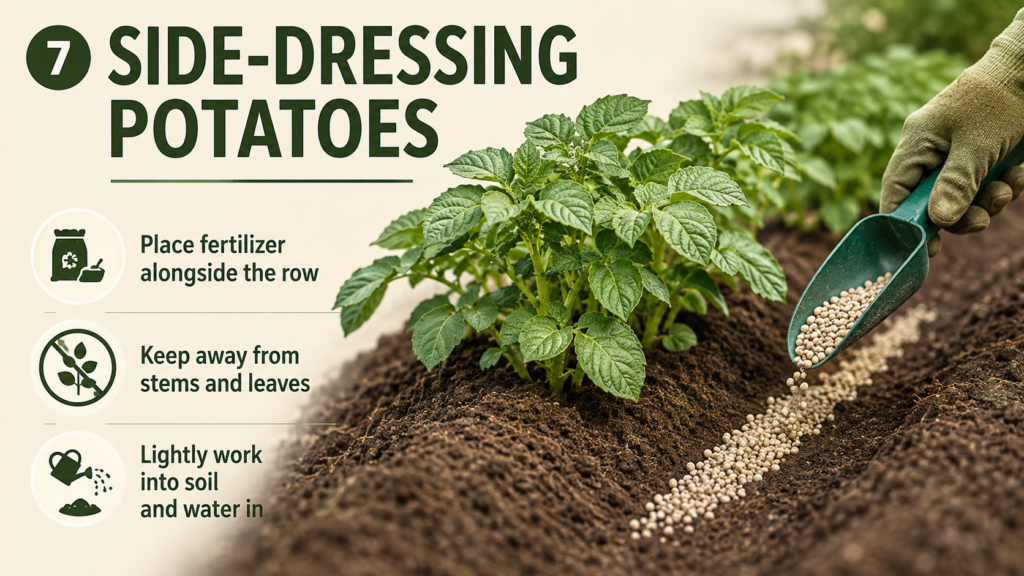
Side-dressing means applying fertilizer alongside established plants instead of directly at the stem. It is useful when the nutrient program is split between planting and early growth.
- Place the fertilizer in a narrow band beside the row, not against the stems.
- Follow the product rate carefully.
- Lightly incorporate granular fertilizer if the label recommends it.
- Water appropriately after application so nutrients can move into the root zone, while avoiding excessive irrigation that can leach nutrients.
How Often Should You Fertilize Potatoes?
Potatoes do not need to be fertilized every week. Many home-garden programs use a base application at or before planting and one additional early-season application, while other soils require different schedules. The number of feedings depends on fertilizer type, soil fertility, rainfall or irrigation, and whether the nutrients are supplied in slow-release, granular or liquid form.
The safest rule is to follow a soil-test recommendation and the fertilizer label. More frequent feeding is not automatically better.
Do Potatoes Need Nitrogen?
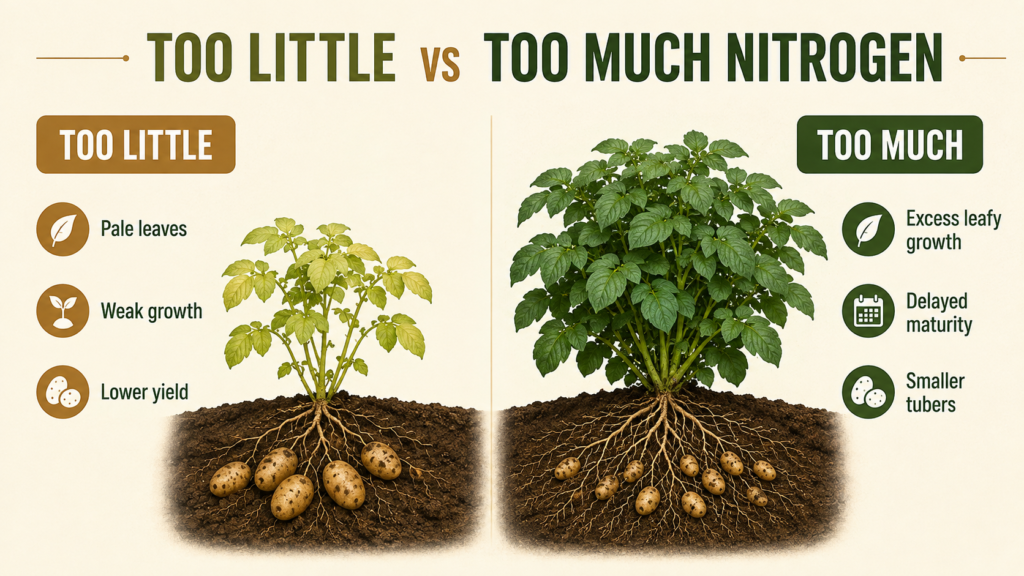
Yes. Potatoes need nitrogen to build the canopy that captures light and powers tuber growth. The goal is sufficient nitrogen early, followed by balanced nutrition as tubers develop.
| Too little nitrogen may contribute to | Too much or poorly timed nitrogen may contribute to |
| Pale foliage | Very lush top growth |
| Weak, limited canopy | Delayed maturity |
| Reduced vigor | A crop that stays vegetative longer than desired |
| Lower yield potential | Unbalanced growth and possible tuber-quality issues |
These symptoms are not unique to nitrogen. Disease, root injury, water stress, low temperature and other nutrient problems can look similar, so avoid diagnosing from leaf color alone.
Why Potatoes Need Potassium (Potash)
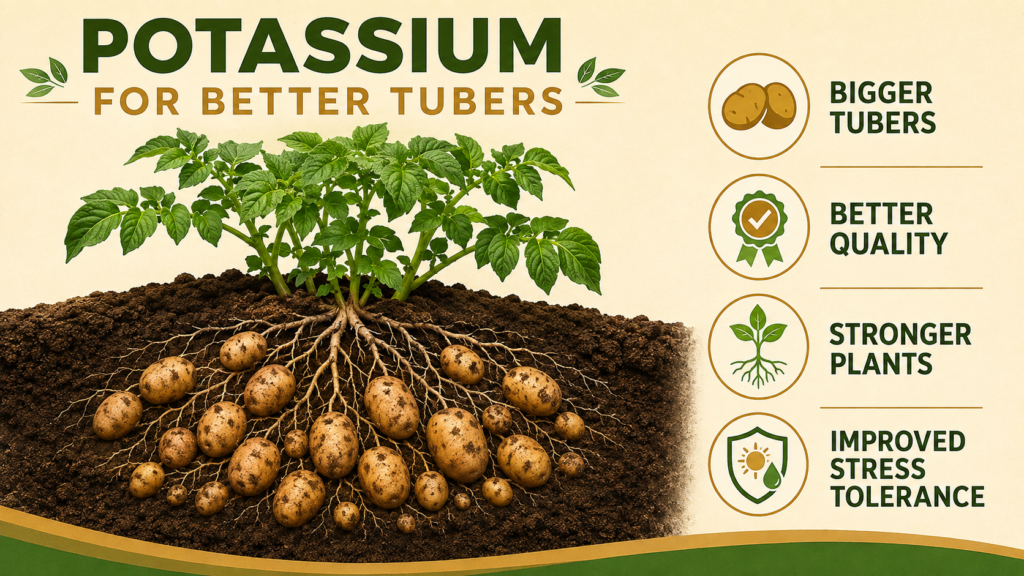
Potassium is one of the nutrients most closely associated with potato performance. It supports water regulation, enzyme activity and tuber growth and quality. This is why potassium fertilizer or potash appears frequently in potato recommendations.
Choose the potassium source and rate based on soil test results and the fertilizer program. Do not assume that adding wood ash is a harmless way to supply potassium: ash can raise soil pH, which may be undesirable for potatoes.
Is Bone Meal Good for Potatoes?
Bone meal can be useful when additional phosphorus is needed. It is not a complete potato fertilizer because it supplies little or no potassium and only limited nitrogen. If your soil already tests high in phosphorus, adding bone meal simply because potatoes are a tuber crop may be unnecessary.
Is Blood Meal Good for Potatoes?
Blood meal is a concentrated organic nitrogen source. It can be useful where nitrogen is genuinely needed, particularly during early growth, but it is not a balanced potato fertilizer. Because the nitrogen concentration is high, measure carefully and avoid late, heavy applications that encourage excessive vegetative growth.
Best Organic Fertilizers for Potatoes
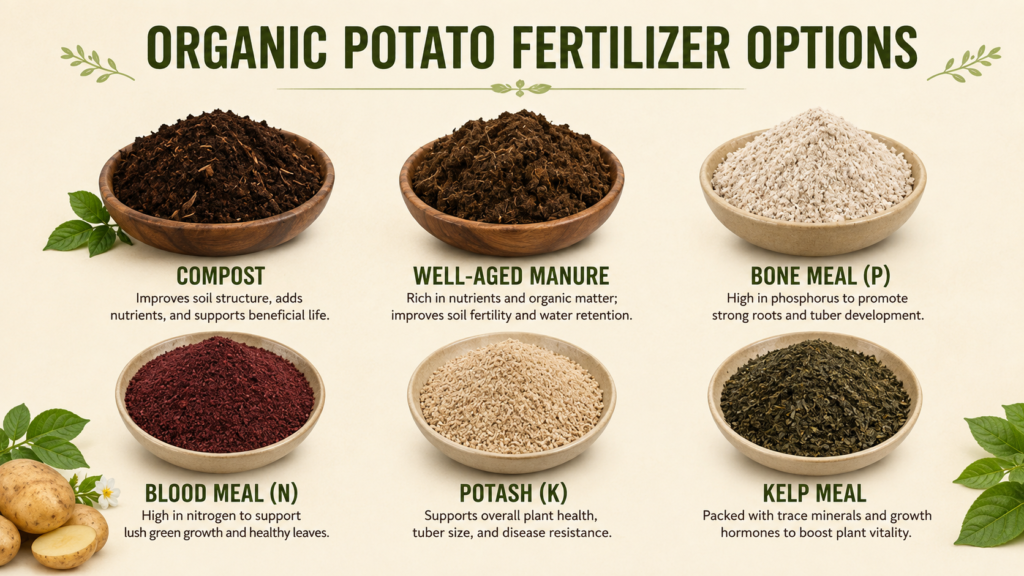
Organic potato fertilization works best when it is treated as nutrient management rather than a collection of “natural” ingredients. Compost improves soil structure and contributes modest nutrition, while complete organic fertilizers can supply a more predictable NPK balance. Targeted products such as bone meal, blood meal and potassium sources should be used for a specific deficiency or plan.
| Organic option | Main role | Watch for |
| Finished compost | Organic matter, soil structure, modest broad nutrition | Nutrient content is variable and may not meet the full crop demand. |
| Well-aged manure | Organic matter plus nutrients | Fresh or overly rich manure can be too salty or nitrogen-rich; compost it appropriately. |
| Complete organic vegetable fertilizer | Convenient balanced nutrient source | Use label rate; “organic” does not mean it cannot burn plants. |
| Bone meal | Primarily phosphorus and calcium | Unnecessary if soil phosphorus is already high. |
| Blood meal | Concentrated nitrogen | Easy to overapply; not a complete fertilizer. |
| Potassium source / potash fertilizer | Potassium | Match rate to soil need; consider pH effects of materials such as wood ash. |
| Kelp or seaweed products | Supplemental nutrients and trace elements | NPK is often too low or variable to serve as the only fertilizer for a demanding crop. |
Can You Make Homemade Fertilizer for Potatoes?
You can make compost and other soil amendments at home, but it is difficult to create a precise homemade NPK fertilizer without knowing the nutrient content of each ingredient. Recipes built around banana peels, coffee grounds, eggshells or kitchen scraps may add organic matter over time, but they should not be treated as a measured substitute for a soil-test-based fertilizer program.
A better approach is to use finished compost for soil health and then add a known fertilizer only when the crop or soil requires it.
Fertilizing Potatoes in Containers and Grow Bags

Container potatoes need the same nutrients as garden potatoes, but the root volume is smaller and nutrients can leach with repeated watering. Start by checking whether the potting mix already contains starter fertilizer. If it does, adding a full fertilizer dose immediately can create unnecessary salt buildup.
- Use a large container with good drainage.
- Choose a complete fertilizer appropriate for vegetables or potatoes.
- Apply according to the product label rather than copying an in-ground rate.
- Split feeding can be useful because repeated watering can wash nutrients from the mix.
- Watch moisture carefully: excess watering can both stress roots and leach nutrients.
Slow-Release vs. Liquid Fertilizer for Potatoes
| Type | Where it can fit | Main caution |
| Granular / slow-release | Base feeding in beds or containers; convenient for steady nutrient supply. | Release rate changes with moisture and temperature; do not add extra feed automatically. |
| Water-soluble / liquid | Useful for measured supplemental feeding, especially in containers. | Easy to overuse if applied too frequently or at excessive concentration. |
| Organic granular | Can provide a slower, broader nutrient release. | Nutrient availability varies by temperature, moisture and microbial activity. |
Signs Potato Plants May Need More Nutrients
Possible nutrient-related warning signs include pale foliage, weak growth, reduced vigor and poor development. However, these signs are not specific enough to diagnose a deficiency on appearance alone. Check soil moisture, root health, pests, disease and temperature before adding fertilizer “just in case.”
Signs You May Be Overfertilizing Potatoes
- Very lush foliage combined with a history of heavy nitrogen feeding.
- Leaf-edge burn or sudden stress after a strong fertilizer application.
- White salt crust on container soil or pot surfaces.
- Repeated fertilizing despite already fertile soil or pre-fertilized potting mix.
- Delayed maturity after continued high-nitrogen feeding.
Common Potato Fertilizer Mistakes
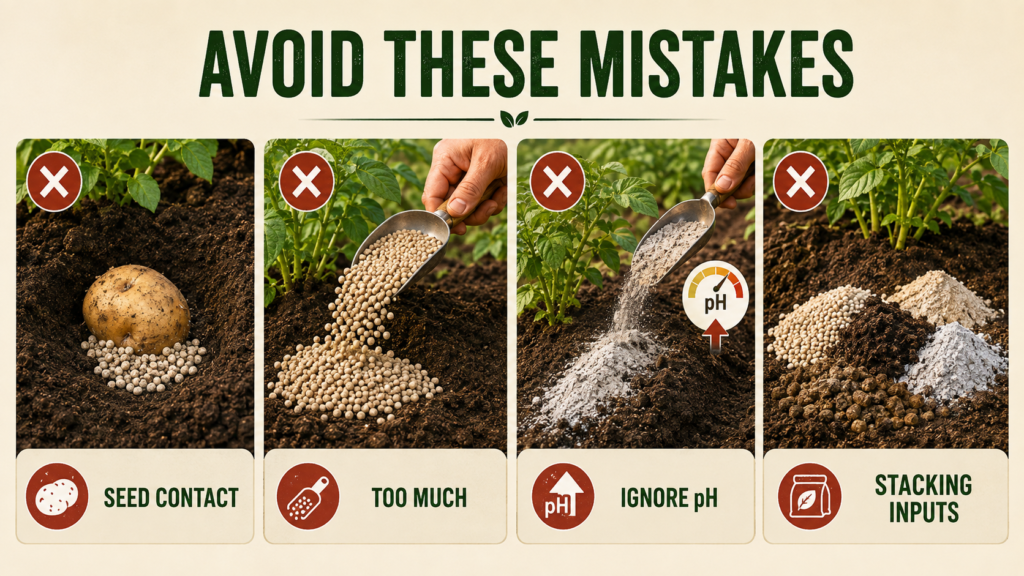
1. Choosing fertilizer by crop name alone instead of checking the soil.
2. Assuming 5-10-10 is perfect for every garden.
3. Assuming 10-10-10 is always bad for potatoes.
4. Treating nitrogen as something potatoes should avoid.
5. Adding large amounts of nitrogen late in the season.
6. Adding phosphorus every year even when soil tests are already high.
7. Placing concentrated fertilizer directly against seed potatoes.
8. Combining compost, manure, bone meal, blood meal and potash without calculating what each contributes.
9. Using wood ash for potassium without considering its effect on soil pH.
10. Fertilizing container potatoes at the same rate as an in-ground bed.
11. Feeding weekly because growth seems slow in cool weather.
12. Assuming more fertilizer automatically means a bigger potato harvest.
Frequently Asked Questions About Potato Fertilizer
What is the best fertilizer for potatoes?
The best fertilizer is the one that supplies nutrients your soil actually lacks. A soil test is the best guide. Where testing is unavailable, 5-10-10 or a balanced vegetable fertilizer may be appropriate depending on local recommendations.
What NPK is best for potatoes?
There is no universal NPK ratio. Potatoes need nitrogen, phosphorus and potassium, but the amount of each added nutrient should reflect existing soil fertility and crop stage.
Is 5-10-10 fertilizer good for potatoes?
Yes, it is a common potato fertilizer and can work well where additional phosphorus and potassium are needed. Follow the label or a local extension rate.
Is 10-10-10 fertilizer good for potatoes?
Yes, it can be. Some extension programs use balanced 10-10-10 fertilizer for home potatoes. It is appropriate only when a balanced input matches the soil’s needs.
Do potatoes need nitrogen?
Yes. Nitrogen is important for early canopy growth and photosynthesis. The concern is excessive or late nitrogen, not nitrogen itself.
Do potatoes need a lot of potassium?
Potatoes have a substantial potassium requirement, but the amount you should add depends on the soil test and fertilizer program.
When should I fertilize potatoes?
Many programs apply a base fertilizer before or at planting and, when needed, another portion during early growth or hilling. Use growth stage rather than a rigid calendar.
How often should I fertilize potatoes?
Usually not weekly. One base application plus one or more planned early-season applications may be enough, depending on the soil and product.
Should I fertilize potatoes at planting?
Often yes, but concentrated fertilizer should not touch the seed piece directly. Place or incorporate it according to the fertilizer label or extension guidance.
Is bone meal good for potatoes?
It can be useful when phosphorus is needed, but it is not a complete fertilizer and may be unnecessary in soil already high in phosphorus.
Is blood meal good for potatoes?
It can supply nitrogen when needed, particularly early, but it is concentrated and should be measured carefully.
What is the best organic fertilizer for potatoes?
A complete organic vegetable fertilizer combined with finished compost is often more balanced than relying on one amendment such as bone meal or blood meal.
Can I use tomato fertilizer on potatoes?
Often yes if the NPK and label directions fit your soil needs. The crop name on the bag matters less than the actual nutrient analysis and application rate.
What fertilizer should I use for potatoes in containers?
Use a complete vegetable fertilizer at the container rate on the label, and first check whether the potting mix already contains fertilizer.
The Bottom Line
The best potato fertilizer is not a magic bag number. Potatoes need nitrogen, phosphorus and potassium, but the correct balance depends on what is already in the soil and where the crop is in its growth cycle. Test the soil when possible, use 5-10-10 or 10-10-10 only when they fit the nutrient need, keep concentrated fertilizer away from seed pieces, and avoid heavy late nitrogen. For most home gardeners, a simple, measured program will outperform repeated “just in case” feeding.