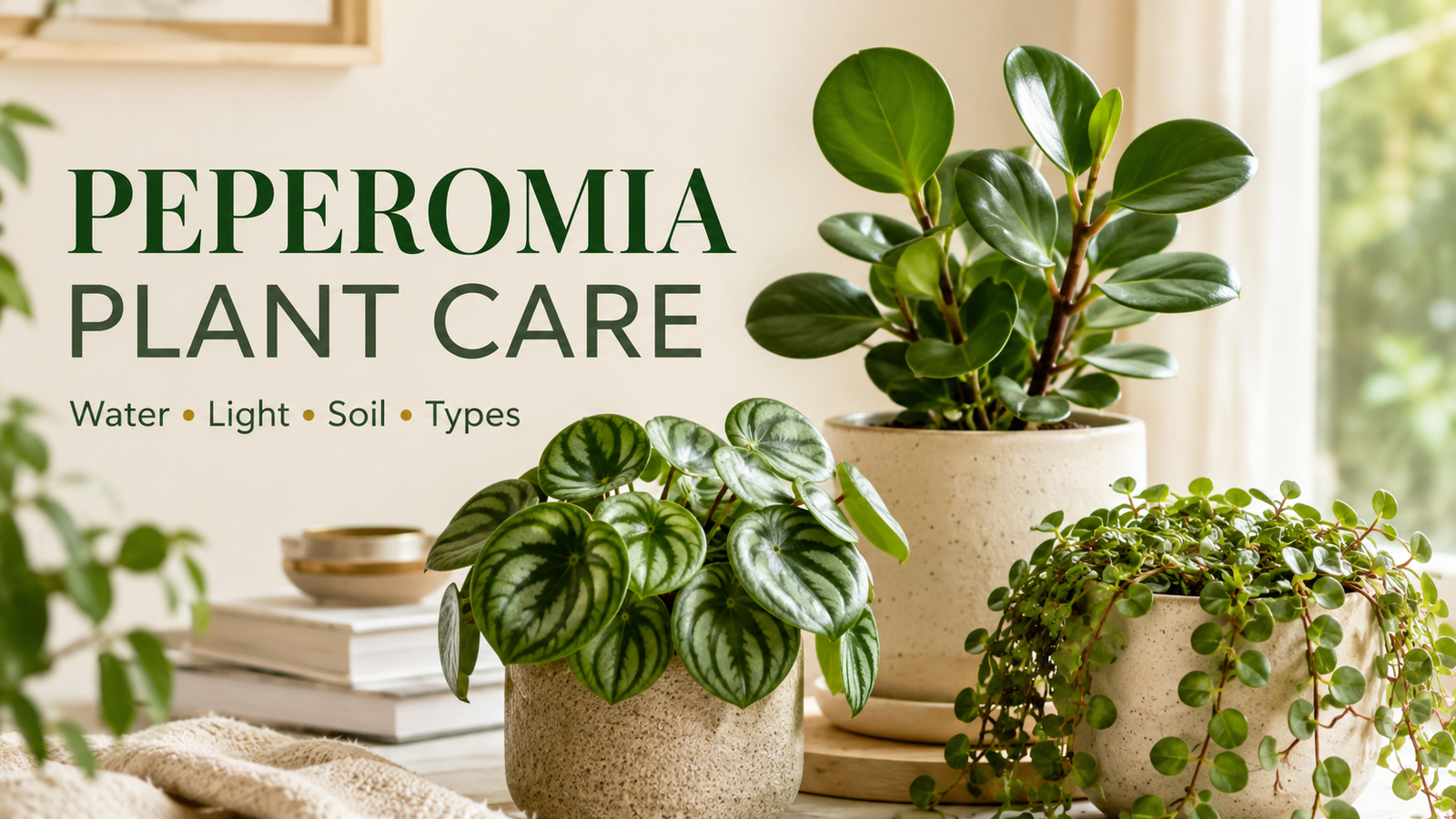

Peperomias are compact tropical houseplants prized for their foliage, manageable size, and generally forgiving nature. Most common Peperomia plants grow best in bright indirect light, an airy well-draining potting mix, and a watering routine that lets the mix partly dry before the next drink. The most common mistake is keeping the roots continuously wet. Because Peperomia is a large genus, individual types can vary slightly, but the same core principle applies: balance light, moisture, and drainage rather than following a rigid calendar.
| Quick answer For most Peperomias, use bright indirect light, let the upper part of the potting mix dry before watering again, and grow the plant in a small pot with excellent drainage. Avoid strong afternoon sun and persistently wet soil. Watering frequency changes with light, temperature, pot size, season, and the Peperomia type you grow. |
Peperomia Care at a Glance

| Care factor | General recommendation | Why it matters |
| Light | Bright indirect light | Supports compact growth and good foliage color without scorching. |
| Water | Let the upper potting mix partially dry | Reduces the risk of root and stem rot. |
| Soil | Airy, well-draining houseplant mix | Keeps oxygen around the roots while retaining moderate moisture. |
| Pot | Container with drainage; avoid oversizing | Large wet volumes of soil can stay damp too long. |
| Temperature | Warm indoor conditions | Peperomias are generally tropical or subtropical plants. |
| Humidity | Average household humidity usually works | Many types appreciate moderate humidity but do not need a greenhouse. |
| Feeding | Light feeding during active growth | Peperomias are not heavy feeders. |
| Repotting | Infrequent; move up one pot size | Compact roots often perform well in smaller pots. |
| Pet safety | Several common species are listed non-toxic to cats and dogs | Still discourage pets from chewing houseplants. |
| Difficulty | Beginner-friendly when not overwatered | Moisture management is the key skill. |
What Is a Peperomia Plant?
Peperomia is not one single houseplant but a large genus in the pepper family, Piperaceae. The genus includes more than a thousand species with very different appearances: some are upright with thick glossy leaves, some have deeply rippled foliage, and others creep or trail over the sides of pots. This diversity explains why a Watermelon Peperomia, String of Turtles, and Baby Rubber Plant can all look unrelated while sharing the same genus name.
The common name “radiator plant” is often applied to Peperomias because of their reputation as warm, adaptable indoor plants. It should not be taken literally: a hot radiator or heater can dry the plant rapidly and expose it to damaging temperature swings.
How to Care for Peperomia
The simplest Peperomia care formula is bright filtered light, controlled watering, an airy root zone, and warm indoor temperatures. These plants often tolerate short dry periods better than constantly wet compost, especially thick-leaved types such as Peperomia obtusifolia. Rather than trying to memorize a weekly schedule, learn to read the potting mix and the plant.
Peperomia Light Requirements

Bright indirect or filtered light is the safest all-purpose target for most indoor Peperomias. A spot close to an east-facing window, a bright north-facing window, or a little back from a strong south- or west-facing window often works well. The room should be clearly bright during the day, but the foliage should not bake in intense direct afternoon sun.
Can Peperomia Grow in Low Light?
Many green-leaved Peperomias tolerate medium or somewhat lower light, but growth usually becomes slower and more stretched as light falls. Peperomia obtusifolia is especially forgiving, while highly patterned or variegated cultivars generally show their best color in brighter indirect light.
Can Peperomia Take Direct Sun?
Short periods of gentle morning sun may be tolerated, especially after gradual acclimation, but strong midday or afternoon sun can fade, bleach, or scorch leaves. If the plant sits near a hot west-facing window, use a sheer curtain or move it slightly back from the glass.
Do Variegated Peperomias Need More Light?
Variegated leaves contain less chlorophyll in their cream, white, or pale sections, so variegated Peperomias usually benefit from brighter indirect light than solid-green forms. Low light can make a plant grow more slowly and may reduce the visual contrast of variegation. Strong direct sun is not the solution; increase safe indirect light instead.
How Often Should You Water Peperomia?
Do not water Peperomia on a fixed “every seven days” or “every ten days” schedule. Water when the upper portion of the potting mix has dried enough for the plant you are growing. In many homes this may work out to roughly every one to two weeks, but the interval can be much shorter or longer depending on season, light, temperature, potting mix, container size, and species.
| Better than counting days Ask “Has the potting mix dried enough?” rather than “How many days has it been?” A Peperomia in a small terracotta pot near a bright window can dry much faster than the same plant in a large plastic pot in winter. |
How to Tell When Peperomia Needs Water
- Feel the upper layer of potting mix. For many common types, water after the upper portion has dried rather than while it still feels cool and damp.
- Lift the pot. A noticeably lighter container usually means the mix has lost a significant amount of water.
- Look at leaf firmness as supporting evidence, not the only test. Some thick-leaved types lose a little firmness when dry.
- Check more deeply if the top looks dry but the pot is large; the lower root zone may still be wet.
How to Water Peperomia Properly

1. Water the potting mix thoroughly until excess water begins to leave the drainage holes.
2. Let the container drain instead of leaving the root ball sitting in water.
3. Empty the saucer or decorative cachepot after drainage.
4. Wait until the mix has partly dried again before the next watering.
How Often to Water Peperomia in Winter
Peperomias usually use water more slowly during cooler, darker months. The same pot that dried in eight days in summer may take two weeks or longer in winter. Keep checking the soil rather than extending the schedule by an arbitrary number of days.
Overwatered vs. Underwatered Peperomia
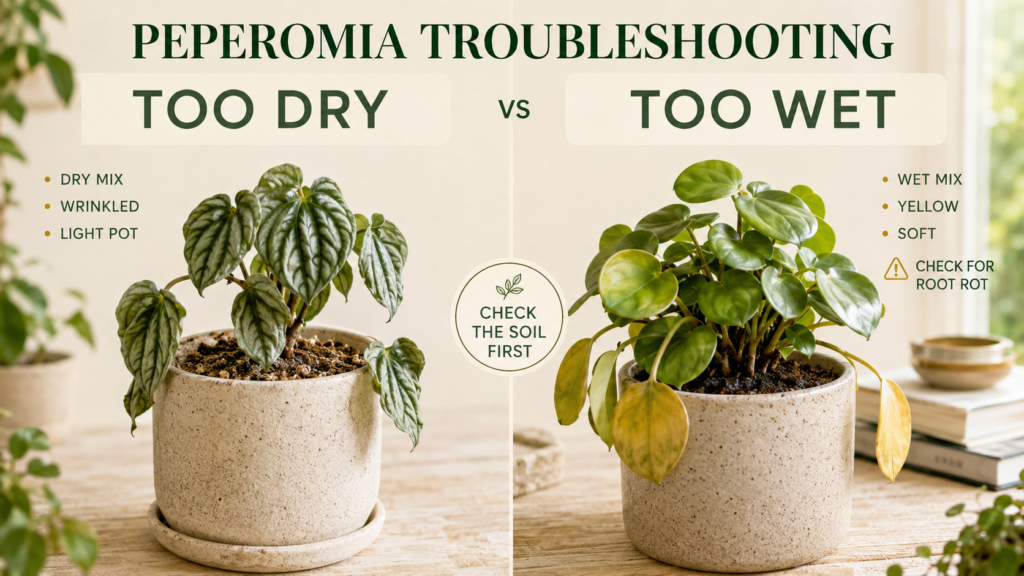
Drooping alone does not tell you whether a Peperomia is too wet or too dry. Always check the potting mix and the stem base before deciding what to do.
| Clue | Possible underwatering | Possible overwatering |
| Potting mix | Very dry; pot feels light | Stays damp for a long time |
| Leaves | May wrinkle, thin, or lose firmness | May yellow, soften, or drop |
| Stems | Usually firm | Base may become soft or dark if rot develops |
| Roots | Dry but generally firm | Brown, mushy, or foul-smelling roots may occur |
| After watering | Often regains firmness if roots are healthy | May continue declining because roots cannot function well |
| Best first action | Rehydrate thoroughly, then resume soil-based checks | Pause watering, improve drainage, inspect roots if decline continues |
Best Soil for Peperomia
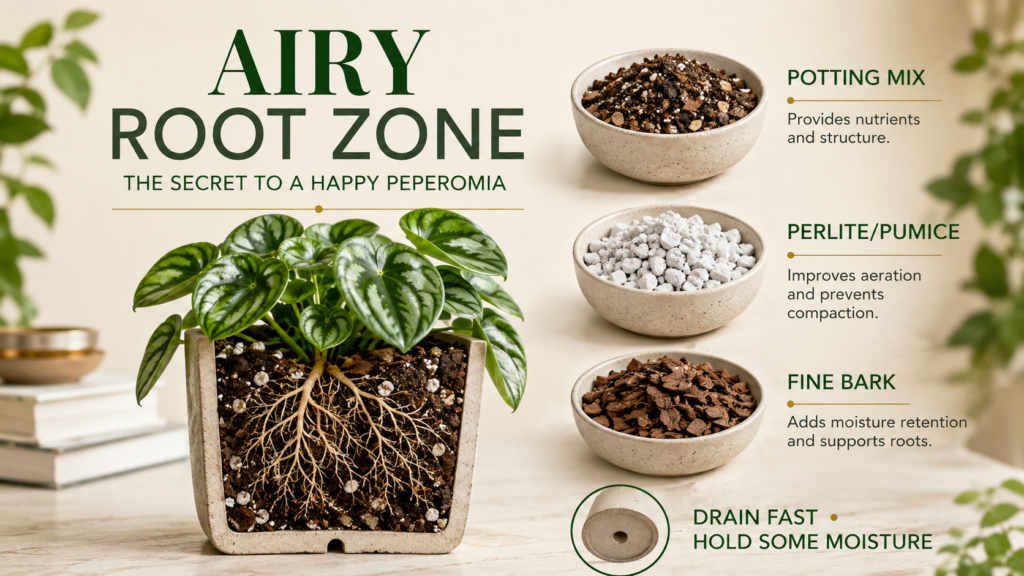
The best soil for Peperomia is less about a single recipe and more about structure. The root zone should hold some moisture but also contain enough air spaces that water drains quickly and the mix does not remain soggy for days. A high-quality indoor potting mix amended with perlite, pumice, or fine bark works well for many common Peperomias.
| Example Peperomia potting mix A practical starting mix is 2 parts quality houseplant potting mix, 1 part perlite or pumice, and 1 part fine orchid bark. Adjust the mix to your climate and watering habits rather than treating one recipe as mandatory. |
Best Pot and Drainage for Peperomia
Use a pot with a drainage hole and avoid jumping to a container that is dramatically larger than the root ball. Peperomias often have compact root systems, and an oversized pot can hold a large volume of wet compost around relatively few roots. When repotting, moving up one pot size is usually safer than doubling the container size.
Terracotta can help frequent waterers because it loses moisture through the pot walls, while plastic retains moisture longer. Either material can work if you adjust watering to the pot and growing conditions.
Temperature and Humidity
Temperature
Most common tropical Peperomias are comfortable in normal warm indoor temperatures. Protect them from cold drafts, chilly window glass, air-conditioning blasts, and rapid temperature swings. If you are comfortable in the room, the plant will usually be comfortable too, provided it is not sitting in a cold or hot microclimate.
Humidity
Average household humidity is adequate for many commonly grown Peperomias. Tropical and trailing types can appreciate moderately humid air, but you do not need to turn the room into a greenhouse. If your home is very dry, group plants, use a humidifier, or move sensitive types away from heating vents rather than relying on constant misting.
How to Fertilize Peperomia
Peperomias are not heavy feeders. During active growth, use a balanced houseplant fertilizer at a diluted rate according to the product label. Feeding every few weeks to monthly during spring and summer is often enough. Reduce feeding when growth slows, and avoid adding fertilizer to a stressed plant with damaged roots or persistently wet soil.
How and When to Repot Peperomia
- Repot when roots have filled the container, drainage has become poor, or the mix has broken down and compacted.
- Choose a new pot only slightly larger than the current root ball.
- Use fresh, airy potting mix and keep the stem base at approximately the same depth.
- Water appropriately after repotting, but do not keep newly disturbed roots constantly wet.
How to Prune Peperomia
Pruning is mainly for shape and sanitation. Remove damaged or yellow leaves, trim excessively long stems, and pinch growing tips if you want a bushier plant. Trailing Peperomias can be shortened when stems become sparse, and the healthy cuttings can often be used for propagation.
Peperomia Propagation

Peperomia is popular with propagators because many species root readily from stem cuttings, and several thick-leaved types can also reproduce from leaf cuttings. Spring and summer are usually the easiest seasons because warmth and active growth encourage faster rooting.
Propagating Peperomia From Stem Cuttings
1. Cut a healthy stem just below a node using clean scissors or pruners.
2. Remove leaves from the lowest node so no foliage is buried or submerged.
3. Root the cutting in water or place it directly in a small pot of lightly moist, airy propagation mix.
4. Keep it warm and in bright indirect light.
5. When new roots and growth are established, pot it into a small Peperomia-appropriate mix.
Propagating Peperomia From Leaf Cuttings
Many fleshy-leaved Peperomias can be propagated from a whole leaf with its petiole, and some can produce new plants from leaf sections. This method is especially useful for compact species but is not equally reliable for every cultivar, particularly highly variegated forms that may not reproduce the same pattern from leaf tissue.
Water vs. Soil Propagation
| Method | Advantages | Trade-offs |
| Water | Easy to see roots and monitor progress | Water-grown roots must later adapt to potting mix |
| Soil | No later water-to-soil transition | Root growth is harder to see and moisture must be controlled carefully |
What Are Peperomia Flowers?
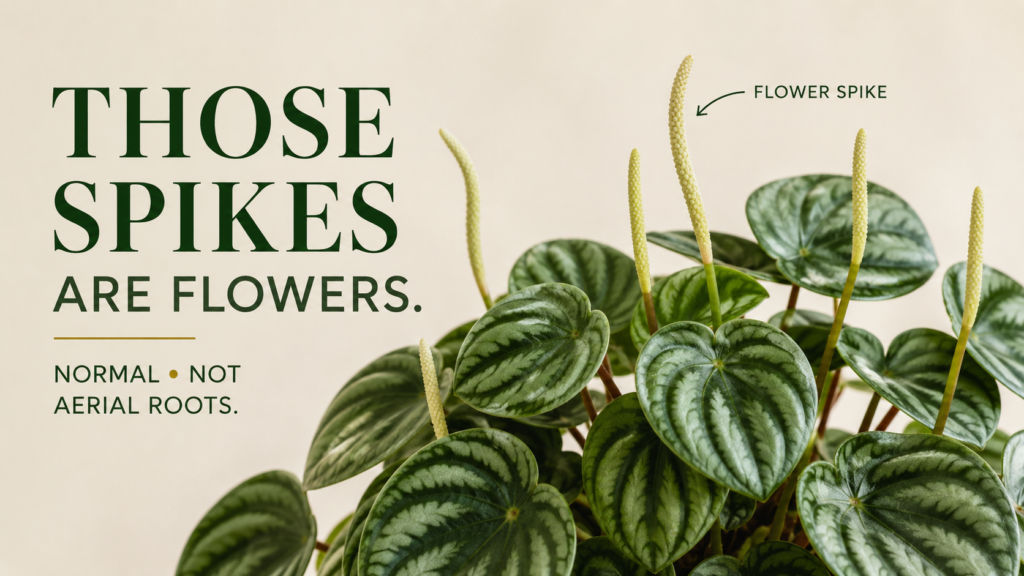
Peperomia flowers are usually slender greenish or cream spikes rather than colorful blossoms. They can look like thin tails or upright candles emerging above the foliage. Flowering is normal and is not a sign that the plant is dying. Because Peperomias are grown primarily for leaves, some owners leave the spikes for interest while others trim them off to keep the plant compact.
What Are Those Spikes on My Peperomia?
If a healthy Peperomia suddenly produces narrow upright spikes without normal leaf blades, you are probably looking at flower spikes. They are not aerial roots and usually do not need treatment.
Common Peperomia Problems
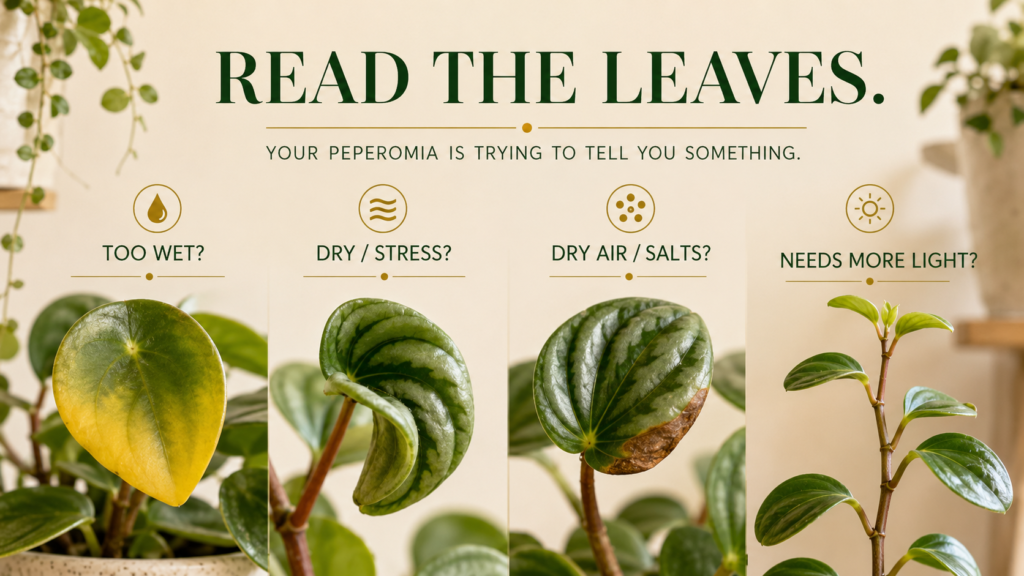
| Problem | Likely possibilities | What to check first |
| Yellow leaves | Persistently wet soil, aging foliage, root stress | Soil moisture and drainage |
| Drooping | Too dry, too wet, temperature stress | Potting mix moisture and stem firmness |
| Curling leaves | Dryness, low humidity, heat or light stress | Moisture, temperature and window exposure |
| Brown tips/edges | Dry air, inconsistent watering, mineral/salt buildup | Watering pattern and environment |
| Leaf drop | Root stress, abrupt environmental change, cold | Moisture history and recent moves |
| Soft/mushy stem base | Stem/root rot | Roots, drainage and wet soil |
| Leggy growth | Insufficient light | Move to brighter indirect light |
| Faded variegation | Light too low or growth reverting | Increase safe indirect light |
| Sticky residue/cottony pests | Mealybugs or scale | Leaf axils, undersides and stems |
How to Handle Root Rot
If the plant is declining while the potting mix stays wet, inspect the roots. Healthy roots should feel firm. Remove badly rotted tissue with clean tools, discard waterlogged mix, and repot the remaining healthy plant into a smaller, well-draining setup. Correcting the wet conditions is more important than adding fertilizer or repeatedly watering a wilting plant.
Is Peperomia Toxic to Cats?
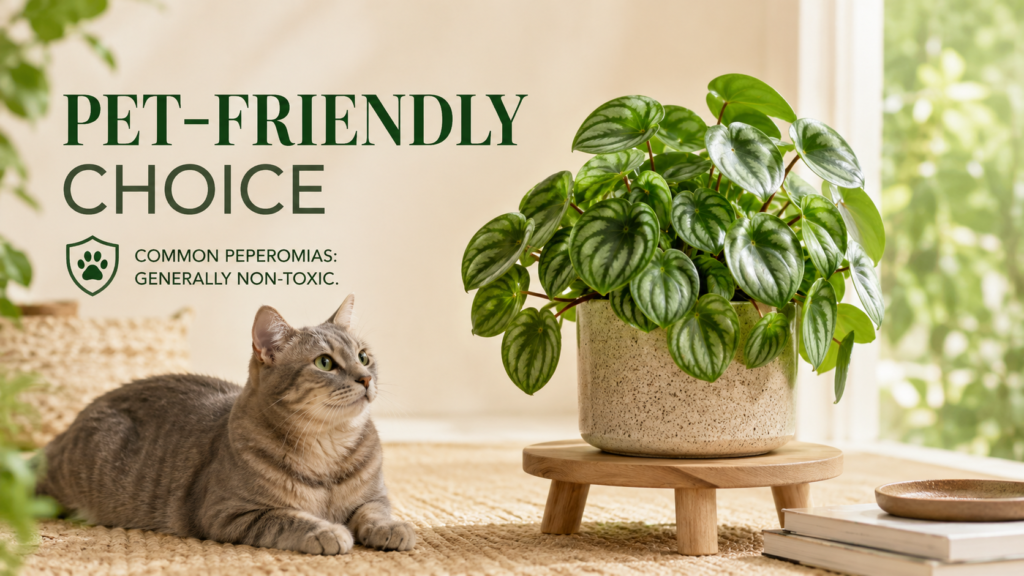
Several commonly grown Peperomia species, including Baby Rubber Plant and several ripple or trailing Peperomias, are listed by the ASPCA as non-toxic to cats and dogs. That makes Peperomia a popular choice for pet households. However, “non-toxic” does not mean edible; chewing a large amount of any plant material can still upset a pet’s stomach, so discourage repeated chewing.
Popular Types of Peperomia
Most common Peperomias follow the same broad care framework, but growth habit and moisture tolerance differ. Use these profiles to identify the plant you have, then fine-tune watering and light rather than assuming every Peperomia behaves identically.
Peperomia obtusifolia – Baby Rubber Plant
Peperomia obtusifolia has thick, glossy, rounded leaves on upright fleshy stems. It is one of the most forgiving Peperomias and handles medium light better than many highly patterned types. Its fleshy foliage stores water, so letting the potting mix partly dry is especially important. Green forms tolerate lower light better than heavily variegated forms.
Variegated Peperomia obtusifolia, Golden Gate and Marble
Variegated obtusifolia cultivars add cream, pale green, or yellow patterns to the thick baby-rubber-plant leaves. Golden Gate is known for green leaves with creamy margins, while “Marble” is used for marbled variegated forms in the trade. Give these plants brighter indirect light than solid-green obtusifolia to support strong variegation, but protect the pale tissue from harsh direct sun.
Watermelon Peperomia
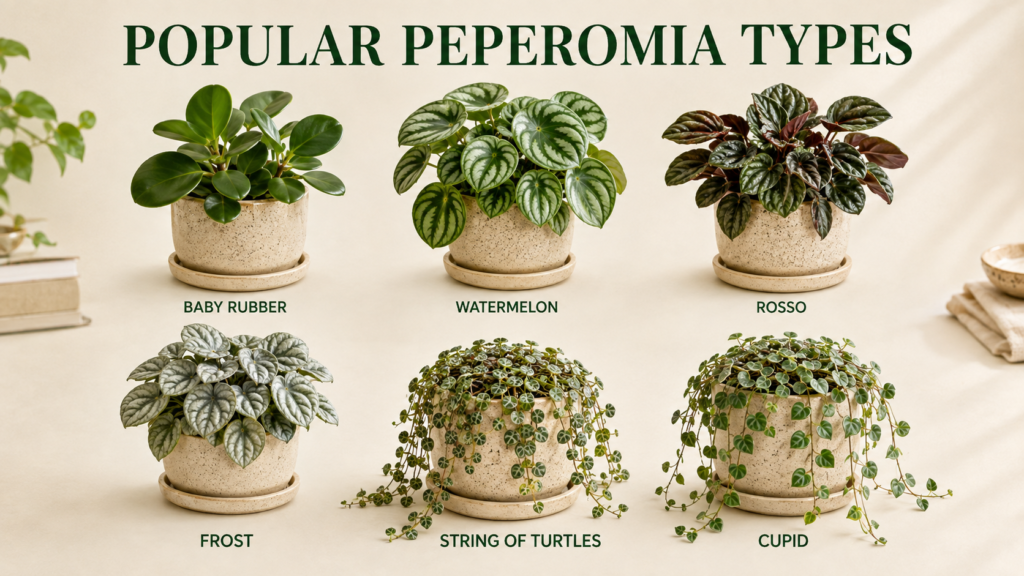
Watermelon Peperomia, Peperomia argyreia, has rounded leaves with silver and dark-green striping that resembles watermelon rind. It prefers bright indirect light and careful moisture control. Its leaves are thinner than obtusifolia, so avoid leaving it bone dry for long periods, but do not keep the root zone constantly wet. Good drainage is essential.
Peperomia caperata – Ripple Peperomia, Rosso and Frost
Peperomia caperata forms compact rosettes of deeply textured or rippled leaves. Rosso has narrow ridged green leaves with reddish undersides, while Frost is valued for silvery foliage. These plants generally enjoy medium to bright filtered light and an airy mix that is allowed to dry somewhat between waterings. Their textured leaves make water sitting in the crown undesirable.
Peperomia prostrata – String of Turtles
String of Turtles is a delicate trailing Peperomia with tiny rounded leaves patterned like turtle shells. It prefers bright indirect light and often performs best with slightly more even moisture and humidity than thick-leaved obtusifolia. Avoid both prolonged drought and waterlogged soil. A shallow, well-draining pot suits its compact root system.
Peperomia rotundifolia
Peperomia rotundifolia is a trailing plant with small rounded semi-succulent leaves. It works well in hanging containers and mixed displays. Let the mix partly dry, but watch small pots because they can dry quickly. Yellowing often points toward excessive moisture, while curling can accompany dry conditions or environmental stress.
Cupid Peperomia
Cupid Peperomia is a trailing or vining type with heart-shaped leaves, often sold in variegated forms. Give it bright indirect light for compact growth and good color, plus moist-but-well-drained conditions with partial drying between waterings. Trim long stems to encourage branching.
Happy Bean Peperomia
Happy Bean Peperomia has narrow, curved, bean-like succulent leaves and a more drought-tolerant appearance than many broad-leaved species. Grow it in very well-draining mix and bright indirect light. Its succulent foliage is a reminder not to keep the roots continuously wet.
Do All Peperomia Types Need the Same Care?
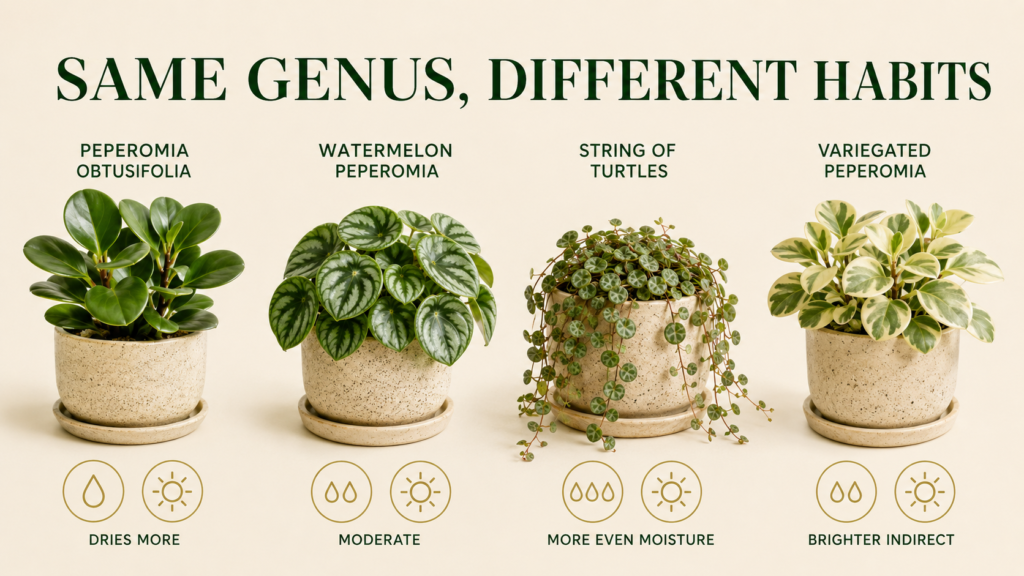
| Type | Moisture tendency | Light | Growth habit |
| Peperomia obtusifolia | Allow more drying | Medium to bright indirect | Upright |
| Watermelon Peperomia | Moderate partial drying | Bright indirect | Compact rosette |
| String of Turtles | Slightly more even moisture | Bright indirect | Trailing |
| Peperomia caperata | Moderate partial drying | Medium to bright filtered | Compact |
| Variegated forms | Moderate; avoid sogginess | Brighter indirect light | Varies |
| Happy Bean | Allow more drying | Bright indirect | Upright/succulent |
Frequently Asked Questions About Peperomia Care
How often should I water Peperomia?
Check the soil rather than watering on a fixed calendar. For many common Peperomias, water after the upper part of the potting mix has dried, then water thoroughly and let the excess drain.
Does Peperomia like direct sunlight?
Most Peperomias prefer bright indirect light. Gentle morning sun may be tolerated, but strong midday or afternoon sun can scorch the foliage.
Can Peperomia grow in low light?
Many green-leaved types tolerate medium or lower light, but growth may slow or stretch. Variegated and highly patterned types usually perform better in brighter indirect light.
What is the best soil for Peperomia?
Use an airy, well-draining houseplant mix that holds some moisture without staying soggy. Perlite, pumice, and fine bark can improve drainage and root aeration.
Should I mist Peperomia?
Misting is not essential for most common Peperomias. Average household humidity usually works. If your air is very dry, a humidifier is more effective than occasional misting.
Do Peperomias like small pots?
They often perform well in relatively snug pots because their root systems are compact. When repotting, choose a container only slightly larger than the existing root ball.
Why is my Peperomia drooping?
Both dry and overly wet roots can cause drooping. Check the potting mix before watering and look for soft stems or persistently wet soil.
Why are my Peperomia leaves turning yellow?
Persistently wet soil is a common cause, but aging leaves, root stress, nutrient issues, or environmental changes can also contribute.
Is Peperomia toxic to cats?
Several common Peperomia species are listed by the ASPCA as non-toxic to cats and dogs. Still discourage pets from eating plant material.
Can Peperomia grow in water?
Stem cuttings can root in water, but long-term growth is usually easier in a well-draining potting mix unless you are intentionally using a hydroponic system.
How do you propagate Peperomia?
Stem cuttings are broadly useful, while many fleshy-leaved types also propagate from leaves. Keep cuttings warm, bright but out of direct sun, and only lightly moist while roots form.
Should I cut off Peperomia flowers?
You can leave the slender flower spikes or trim them off for appearance. Removing them is not necessary for plant health.
Is a radiator plant a Peperomia?
“Radiator plant” is a common name used for Peperomias. It does not mean the plant should be placed next to a hot radiator.
What is the easiest Peperomia to grow?
Peperomia obtusifolia is one of the most forgiving choices because of its thick leaves, compact growth, and tolerance of a range of indoor light conditions.
The Bottom Line
Peperomia care is less about following a rigid schedule and more about balancing light, moisture, and drainage for the type you grow. Give the plant bright indirect light, let the potting mix partly dry before watering again, keep the roots in an airy mix and a sensibly sized pot, and adjust for the differences between thick-leaved, rippled, variegated, and trailing species. Once you learn to check the soil before watering, most Peperomias become remarkably manageable indoor plants.